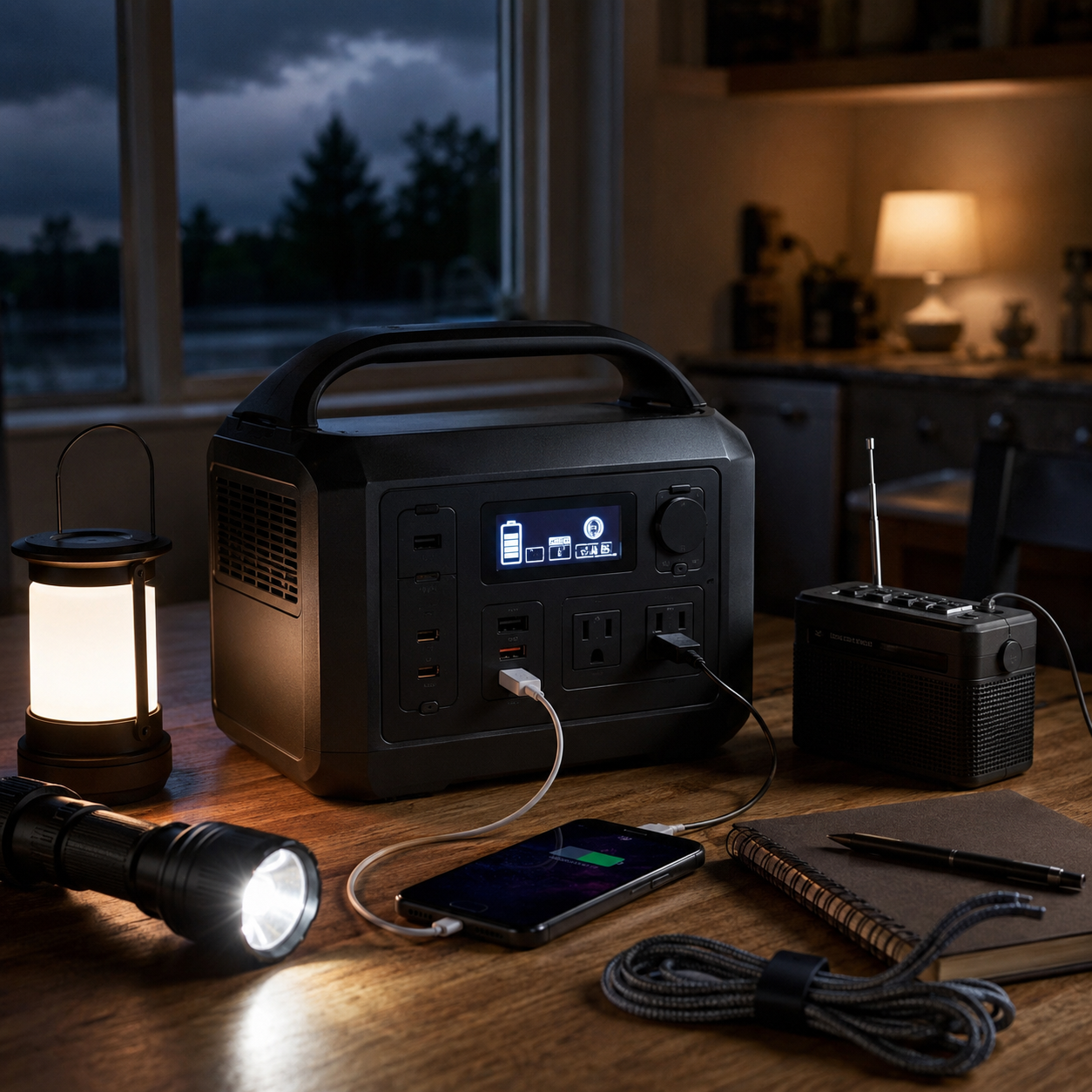
Portable power stations are becoming one of the most useful additions to a modern emergency kit.
They can keep phones charged, run lights and fans, support internet equipment, power a laptop, and—in the right size—keep a refrigerator operating during a blackout. They are also useful for camping, RV trips, remote work, photography, and outdoor projects.
However, choosing one can be confusing.
One model may advertise a huge battery but have limited output. Another may run powerful appliances but empty its battery quickly. Some are easy to carry, while others are technically portable only because they have wheels.
Before recommending a specific model, the most important question is:
What do you actually need it to power, and for how long?
Here is a practical breakdown of several strong options and how to choose the right one without overspending.
Quick Recommendations
For most people, these are the categories worth considering:
| Power station | Best suited for | Capacity | Rated AC output |
|---|---|---|---|
| EcoFlow DELTA 3 Plus | Best general-purpose choice | 1,024Wh | 1,800W |
| Anker SOLIX C1000 Gen 2 | Best compact high-output choice | 1,024Wh | 2,000W |
| Jackery Explorer 1000 V2 | Best for portability and simple operation | 1,070Wh | 1,500W |
| BLUETTI Elite 200 V2 | Best for longer outages | 2,073.6Wh | 2,600W |
| EcoFlow DELTA Pro 3 | Best for serious home backup | 4,096Wh | 4,000W |
Specifications may vary by country because manufacturers sell different 120-volt and 230-volt versions.
1. EcoFlow DELTA 3 Plus: Best All-Around Recommendation
The EcoFlow DELTA 3 Plus is a strong starting point for households that want one power station for both camping and emergency use.
It has:
- 1,024Wh of battery capacity
- 1,800W of continuous AC output
- Up to 3,600W of surge output
- LiFePO₄ battery chemistry
- Fast AC charging
- Solar-charging support
- Expandable battery options
- UPS-style backup capability
EcoFlow says the DELTA 3 Plus can recharge from zero to full in approximately 56 minutes using its maximum AC charging mode. It also offers 1,800W of standard AC output and supports compatible expansion batteries. (EcoFlow)
What it can realistically power
Depending on the appliance and total load, it may operate:
- Refrigerator
- Chest freezer
- Television
- Internet router
- Laptops
- CPAP machine
- Fans
- Lights
- Coffee maker
- Microwave used briefly
- Small power tools
Its 1,024Wh battery is enough for meaningful emergency use, but not for running high-wattage equipment continuously.
For example, a 1,500W space heater could drain a battery of this size very quickly. A refrigerator is more practical because its compressor cycles on and off rather than drawing full power continuously.
Best for
The DELTA 3 Plus is best for someone who wants a versatile unit that can move between the home, vehicle, campsite, and home office.
2. Anker SOLIX C1000 Gen 2: Best Power-to-Weight Choice
The Anker SOLIX C1000 Gen 2 is worth considering when portability and inverter output matter more than maximum runtime.
It provides:
- 1,024Wh capacity
- 2,000W continuous output
- 3,000W peak output
- Ten output ports on the U.S. version
- LiFePO₄ battery chemistry
- Approximately 49-minute maximum-speed AC charging
- UPS-style transfer in approximately 10 milliseconds
Anker lists the C1000 Gen 2 with 2,000W of continuous output, a 3,000W peak rating, and a 1,024Wh battery. The company also advertises a 49-minute full recharge when its high-speed charging mode is enabled.
Why it stands out
Many 1kWh power stations provide between 1,500W and 1,800W of continuous AC output.
The Anker delivers 2,000W while remaining relatively compact. That gives it extra headroom for appliances such as:
- Microwaves
- Coffee makers
- Electric kettles
- Small cooking devices
- Power tools
- Refrigerators with higher starting surges
However, high output should not be confused with long runtime.
A 2,000W appliance could theoretically consume the entire 1,024Wh battery in well under one hour after efficiency losses. The station can provide high power, but it cannot provide that power indefinitely.
Best for
Choose the C1000 Gen 2 when you want a compact station that can start demanding equipment but will mainly be used for short outages, camping, or portable work.
3. Jackery Explorer 1000 V2: Best for Simple, Portable Backup
Jackery has become a familiar name among campers and emergency-preparedness buyers, and the Explorer 1000 V2 is one of its most practical mid-sized units.
Its main specifications include:
- 1,070Wh capacity
- 1,500W continuous output
- 3,000W surge output
- Approximately 23.8-pound weight
- LiFePO₄ battery
- Dual 100W USB-C ports
- Emergency high-speed charging mode
Jackery lists the Explorer 1000 V2 with a 1,070Wh battery and approximately 23.8-pound weight. The company also offers an emergency charging mode that can recharge the unit in roughly one hour under specified conditions.
Why people like it
The Explorer 1000 V2 is relatively easy to understand and carry. It is well suited to users who do not want an especially large or complicated system.
It can handle many common emergency loads, including:
- Phones and tablets
- Laptops
- Lights
- Fans
- Internet equipment
- CPAP machines
- Televisions
- Many refrigerators
- Small kitchen appliances within its rating
Its 1,500W output is lower than that of the EcoFlow and Anker models above, so you must be more careful when connecting several high-wattage devices simultaneously.
Best for
The Jackery is a good match for camping, apartments, small homes, road trips, and people who prioritize manageable weight over maximum inverter output.
4. BLUETTI Elite 200 V2: Best for Longer Outages
A 1kWh station is useful, but some households need more stored energy.
The BLUETTI Elite 200 V2 roughly doubles the battery capacity of the smaller recommendations, offering:
- 2,073.6Wh capacity
- 2,600W continuous output
- Up to 3,900W peak-load support
- LiFePO₄ battery chemistry
- Four AC outlets on the U.S. version
- Solar charging
- Enough output for multiple household appliances
BLUETTI lists the Elite 200 V2 with 2,073.6Wh of capacity and 2,600W of rated output. The company says it can power as many as nine devices simultaneously, provided the combined load remains within the station’s limits.
Why the larger battery matters
During a blackout, a larger unit allows you to rotate essential loads rather than choosing only one device.
For example, you might use it to:
- Keep the refrigerator cold
- Recharge phones
- Run the router
- Operate several lights
- Power a fan
- Use a microwave briefly
- Recharge cordless-tool batteries
A 2kWh station also provides a more comfortable reserve for overnight use.
The downside
The Elite 200 V2 is substantially heavier than a 1kWh model.
It is better for a garage, RV, workshop, vehicle, or designated emergency area than for carrying long distances.
Best for
Choose this size when your priority is refrigerator backup, longer outages, RV use, or supporting several essential devices.
5. EcoFlow DELTA Pro 3: Best for Serious Home Backup
The EcoFlow DELTA Pro 3 belongs in a different category from ordinary camping batteries.
It is a large, wheeled energy-storage system with:
- 4,096Wh base capacity
- 4,000W continuous output
- 120V and 240V support on compatible U.S. configurations
- Expandable battery options
- Solar-charging capability
- Home-integration accessories
- Enough power for several larger appliances
EcoFlow lists the DELTA Pro 3 with 4,000W of rated output and support for both 120V and 240V loads in compatible configurations. The company positions it for appliances such as pumps, air conditioners, refrigerators, garage-door openers, and kitchen equipment.
What it is designed for
This kind of station can support:
- Refrigerator and freezer
- Lights and internet
- Well or sump pumps within specifications
- Selected kitchen appliances
- Home-office equipment
- RV systems
- Critical household circuits with approved integration equipment
It may also be paired with extra batteries and solar panels for longer runtime.
The downside
This is not a lightweight unit. It is better described as movable than easily portable.
It is also considerably more expensive than a 1kWh station, especially after adding batteries, solar panels, or home-integration hardware.
Best for
The DELTA Pro 3 is appropriate when you want serious emergency backup and have already identified the circuits and appliances you need to support.
How Much Capacity Do You Actually Need?
Battery capacity is measured in watt-hours, written as Wh.
A rough runtime formula is:
Battery capacity × 0.85 ÷ appliance wattage = estimated hours
The 0.85 accounts for typical inverter and conversion losses. Actual performance varies.
Example: 1,024Wh station powering a 50W load
1,024 × 0.85 ÷ 50 = approximately 17.4 hours
Example: 1,024Wh station powering a 500W load
1,024 × 0.85 ÷ 500 = approximately 1.7 hours
Example: 2,073Wh station powering a 100W load
2,073 × 0.85 ÷ 100 = approximately 17.6 hours
These are estimates rather than guarantees. Temperature, inverter efficiency, battery age, cable losses, and appliance cycling all affect runtime.
Recommended Sizes by Use
Phones, lights, cameras, and laptops
Look for approximately:
- 250Wh to 500Wh
- 300W to 600W output
This size is easy to carry but is usually too small for dependable refrigerator backup.
Camping and short blackouts
Look for approximately:
- 700Wh to 1,200Wh
- 1,000W to 2,000W output
This range works well for electronics, lights, fans, internet equipment, medical devices, and limited appliance use.
Refrigerator and overnight household backup
Look for approximately:
- 1,500Wh to 2,500Wh
- At least 1,800W output
- Adequate surge capacity for the compressor
A 2kWh station provides more flexibility than a 1kWh unit during an overnight outage.
Several appliances or household circuits
Look for:
- 3,000Wh or more
- 3,000W or more continuous output
- Expansion-battery support
- Appropriate 120V or 240V capability
- Approved home-integration equipment
What Features Should You Look For?
LiFePO₄ battery chemistry
Lithium iron phosphate, commonly written as LiFePO₄ or LFP, has become the preferred chemistry in many current power stations.
It generally provides a longer cycle life and better thermal stability than older nickel-manganese-cobalt battery designs.
That does not make the station indestructible. It still requires proper storage, charging, ventilation, and protection from moisture and extreme heat.
Pure sine-wave output
Choose a station with a pure sine-wave inverter when powering sensitive electronics, motors, refrigeration equipment, CPAP machines, or audio equipment.
Most reputable current models provide pure sine-wave AC, but verify the specification.
Enough continuous output
Add the wattage of everything you plan to operate at the same time.
For example:
- Refrigerator: 150W while running
- Router: 15W
- Laptop: 65W
- Fan: 50W
- Lights: 20W
Combined running load:
150 + 15 + 65 + 50 + 20 = 300W
However, the refrigerator may briefly require much more power when its compressor starts. Your station must handle both continuous and startup loads.
Fast AC charging
Fast charging is valuable when a storm warning gives you only a short time to prepare.
However, the fastest setting may produce more fan noise and heat. Slower charging may be preferable during routine use.
Solar input
Solar panels can help during extended outages, but actual production is usually lower than the panel’s advertised rating.
Clouds, shade, panel angle, heat, cable length, and available daylight all affect output.
Also verify the station’s permitted solar-voltage range before connecting panels. An incorrectly configured solar array can exceed the input limit and damage equipment.
Replaceable or expandable batteries
Expansion support allows you to increase runtime later without replacing the entire station.
This can be useful for:
- Home backup
- RV use
- Off-grid cabins
- Long outages
- Growing solar systems
Useful ports
Check for the ports you genuinely use:
- Standard AC outlets
- USB-A
- High-output USB-C
- Regulated 12V vehicle outlet
- DC5521 or Anderson-style DC ports
- RV outlet
- Expansion-battery connection
Port layouts differ between regional versions.
Can a Portable Power Station Run a Refrigerator?
Usually, yes—provided the inverter can handle the refrigerator’s starting surge.
The actual runtime depends on:
- Refrigerator size
- Energy efficiency
- Room temperature
- How often the compressor cycles
- Door-opening frequency
- Condition of the door seals
- Other devices connected to the power station
A refrigerator may draw only 100W to 300W while its compressor is running, but its startup surge may be considerably higher.
A 1kWh station may support an efficient refrigerator through a shorter outage. A 2kWh unit gives you a larger margin and more room for phones, lighting, and internet equipment.
What Should You Avoid Running?
Power stations can technically operate some high-wattage appliances, but doing so may not be practical.
Use caution with:
- Space heaters
- Hair dryers
- Large electric cooktops
- Electric water heaters
- Clothes dryers
- Large air conditioners
- High-wattage ovens
- Welding equipment
A 1,500W heater could consume most of a 1kWh battery in considerably less than one hour after losses.
During an emergency, reserve battery energy for refrigeration, communication, lighting, ventilation, and medical needs.
Portable Power Station Safety
A rechargeable power station does not produce combustion exhaust during normal battery operation, making it very different from a gasoline generator.
However, it still contains a large amount of stored electrical energy.
Use it safely:
- Keep it dry.
- Do not block ventilation openings.
- Avoid placing it on bedding or soft furniture.
- Do not exceed its rated output.
- Stop using it if it becomes swollen, cracked, unusually hot, or develops an abnormal odor.
- Use charging cables approved by the manufacturer.
- Confirm solar-panel voltage before connecting panels.
- Keep it away from open flames and excessive heat.
- Do not attempt internal repairs unless qualified.
- Never connect it to household wiring through an improvised male-to-male cord.
When powering household circuits, use approved transfer equipment and a properly installed connection system.
My Practical Recommendation
For most households, a 1,000Wh LiFePO₄ power station with at least 1,500W of continuous output is the most sensible place to start.
The EcoFlow DELTA 3 Plus is the strongest general-purpose recommendation because it combines usable capacity, fast charging, expansion support, and appliance-capable output.
The Anker SOLIX C1000 Gen 2 is better when you want higher output from a compact unit.
The Jackery Explorer 1000 V2 is attractive when low weight and straightforward operation matter most.
For longer outages and refrigerator backup, the BLUETTI Elite 200 V2 provides a more useful energy reserve.
For serious household systems, the EcoFlow DELTA Pro 3 offers much more capacity and output, but it also requires a much larger budget and more planning.
The best power station is not automatically the biggest or most expensive one. It is the model that can safely start your essential appliances, run them for a realistic period, recharge through methods available to you, and remain portable enough for your household to use.
Looking for Recommendations on Rechargeable Portable Power Stations? Start Here
Portable power stations are becoming one of the most useful additions to a modern emergency kit.
They can keep phones charged, run lights and fans, support internet equipment, power a laptop, and—in the right size—keep a refrigerator operating during a blackout. They are also useful for camping, RV trips, remote work, photography, and outdoor projects.
However, choosing one can be confusing.
One model may advertise a huge battery but have limited output. Another may run powerful appliances but empty its battery quickly. Some are easy to carry, while others are technically portable only because they have wheels.
Before recommending a specific model, the most important question is:
What do you actually need it to power, and for how long?
Here is a practical breakdown of several strong options and how to choose the right one without overspending.
Quick Recommendations
For most people, these are the categories worth considering:
| Power station | Best suited for | Capacity | Rated AC output |
|---|---|---|---|
| EcoFlow DELTA 3 Plus | Best general-purpose choice | 1,024Wh | 1,800W |
| Anker SOLIX C1000 Gen 2 | Best compact high-output choice | 1,024Wh | 2,000W |
| Jackery Explorer 1000 V2 | Best for portability and simple operation | 1,070Wh | 1,500W |
| BLUETTI Elite 200 V2 | Best for longer outages | 2,073.6Wh | 2,600W |
| EcoFlow DELTA Pro 3 | Best for serious home backup | 4,096Wh | 4,000W |
Specifications may vary by country because manufacturers sell different 120-volt and 230-volt versions.
1. EcoFlow DELTA 3 Plus: Best All-Around Recommendation
The EcoFlow DELTA 3 Plus is a strong starting point for households that want one power station for both camping and emergency use.
It has:
- 1,024Wh of battery capacity
- 1,800W of continuous AC output
- Up to 3,600W of surge output
- LiFePO₄ battery chemistry
- Fast AC charging
- Solar-charging support
- Expandable battery options
- UPS-style backup capability
EcoFlow says the DELTA 3 Plus can recharge from zero to full in approximately 56 minutes using its maximum AC charging mode. It also offers 1,800W of standard AC output and supports compatible expansion batteries. (EcoFlow)
What it can realistically power
Depending on the appliance and total load, it may operate:
- Refrigerator
- Chest freezer
- Television
- Internet router
- Laptops
- CPAP machine
- Fans
- Lights
- Coffee maker
- Microwave used briefly
- Small power tools
Its 1,024Wh battery is enough for meaningful emergency use, but not for running high-wattage equipment continuously.
For example, a 1,500W space heater could drain a battery of this size very quickly. A refrigerator is more practical because its compressor cycles on and off rather than drawing full power continuously.
Best for
The DELTA 3 Plus is best for someone who wants a versatile unit that can move between the home, vehicle, campsite, and home office.
2. Anker SOLIX C1000 Gen 2: Best Power-to-Weight Choice
The Anker SOLIX C1000 Gen 2 is worth considering when portability and inverter output matter more than maximum runtime.
It provides:
- 1,024Wh capacity
- 2,000W continuous output
- 3,000W peak output
- Ten output ports on the U.S. version
- LiFePO₄ battery chemistry
- Approximately 49-minute maximum-speed AC charging
- UPS-style transfer in approximately 10 milliseconds
Anker lists the C1000 Gen 2 with 2,000W of continuous output, a 3,000W peak rating, and a 1,024Wh battery. The company also advertises a 49-minute full recharge when its high-speed charging mode is enabled.
Why it stands out
Many 1kWh power stations provide between 1,500W and 1,800W of continuous AC output.
The Anker delivers 2,000W while remaining relatively compact. That gives it extra headroom for appliances such as:
- Microwaves
- Coffee makers
- Electric kettles
- Small cooking devices
- Power tools
- Refrigerators with higher starting surges
However, high output should not be confused with long runtime.
A 2,000W appliance could theoretically consume the entire 1,024Wh battery in well under one hour after efficiency losses. The station can provide high power, but it cannot provide that power indefinitely.
Best for
Choose the C1000 Gen 2 when you want a compact station that can start demanding equipment but will mainly be used for short outages, camping, or portable work.
3. Jackery Explorer 1000 V2: Best for Simple, Portable Backup
Jackery has become a familiar name among campers and emergency-preparedness buyers, and the Explorer 1000 V2 is one of its most practical mid-sized units.
Its main specifications include:
- 1,070Wh capacity
- 1,500W continuous output
- 3,000W surge output
- Approximately 23.8-pound weight
- LiFePO₄ battery
- Dual 100W USB-C ports
- Emergency high-speed charging mode
Jackery lists the Explorer 1000 V2 with a 1,070Wh battery and approximately 23.8-pound weight. The company also offers an emergency charging mode that can recharge the unit in roughly one hour under specified conditions. (Jackery)
Why people like it
The Explorer 1000 V2 is relatively easy to understand and carry. It is well suited to users who do not want an especially large or complicated system.
It can handle many common emergency loads, including:
- Phones and tablets
- Laptops
- Lights
- Fans
- Internet equipment
- CPAP machines
- Televisions
- Many refrigerators
- Small kitchen appliances within its rating
Its 1,500W output is lower than that of the EcoFlow and Anker models above, so you must be more careful when connecting several high-wattage devices simultaneously.
Best for
The Jackery is a good match for camping, apartments, small homes, road trips, and people who prioritize manageable weight over maximum inverter output.
4. BLUETTI Elite 200 V2: Best for Longer Outages
A 1kWh station is useful, but some households need more stored energy.
The BLUETTI Elite 200 V2 roughly doubles the battery capacity of the smaller recommendations, offering:
- 2,073.6Wh capacity
- 2,600W continuous output
- Up to 3,900W peak-load support
- LiFePO₄ battery chemistry
- Four AC outlets on the U.S. version
- Solar charging
- Enough output for multiple household appliances
BLUETTI lists the Elite 200 V2 with 2,073.6Wh of capacity and 2,600W of rated output. The company says it can power as many as nine devices simultaneously, provided the combined load remains within the station’s limits.
Why the larger battery matters
During a blackout, a larger unit allows you to rotate essential loads rather than choosing only one device.
For example, you might use it to:
- Keep the refrigerator cold
- Recharge phones
- Run the router
- Operate several lights
- Power a fan
- Use a microwave briefly
- Recharge cordless-tool batteries
A 2kWh station also provides a more comfortable reserve for overnight use.
The downside
The Elite 200 V2 is substantially heavier than a 1kWh model.
It is better for a garage, RV, workshop, vehicle, or designated emergency area than for carrying long distances.
Best for
Choose this size when your priority is refrigerator backup, longer outages, RV use, or supporting several essential devices.
5. EcoFlow DELTA Pro 3: Best for Serious Home Backup
The EcoFlow DELTA Pro 3 belongs in a different category from ordinary camping batteries.
It is a large, wheeled energy-storage system with:
- 4,096Wh base capacity
- 4,000W continuous output
- 120V and 240V support on compatible U.S. configurations
- Expandable battery options
- Solar-charging capability
- Home-integration accessories
- Enough power for several larger appliances
EcoFlow lists the DELTA Pro 3 with 4,000W of rated output and support for both 120V and 240V loads in compatible configurations. The company positions it for appliances such as pumps, air conditioners, refrigerators, garage-door openers, and kitchen equipment.
What it is designed for
This kind of station can support:
- Refrigerator and freezer
- Lights and internet
- Well or sump pumps within specifications
- Selected kitchen appliances
- Home-office equipment
- RV systems
- Critical household circuits with approved integration equipment
It may also be paired with extra batteries and solar panels for longer runtime.
The downside
This is not a lightweight unit. It is better described as movable than easily portable.
It is also considerably more expensive than a 1kWh station, especially after adding batteries, solar panels, or home-integration hardware.
Best for
The DELTA Pro 3 is appropriate when you want serious emergency backup and have already identified the circuits and appliances you need to support.
How Much Capacity Do You Actually Need?
Battery capacity is measured in watt-hours, written as Wh.
A rough runtime formula is:
Battery capacity × 0.85 ÷ appliance wattage = estimated hours
The 0.85 accounts for typical inverter and conversion losses. Actual performance varies.
Example: 1,024Wh station powering a 50W load
1,024 × 0.85 ÷ 50 = approximately 17.4 hours
Example: 1,024Wh station powering a 500W load
1,024 × 0.85 ÷ 500 = approximately 1.7 hours
Example: 2,073Wh station powering a 100W load
2,073 × 0.85 ÷ 100 = approximately 17.6 hours
These are estimates rather than guarantees. Temperature, inverter efficiency, battery age, cable losses, and appliance cycling all affect runtime.
Recommended Sizes by Use
Phones, lights, cameras, and laptops
Look for approximately:
- 250Wh to 500Wh
- 300W to 600W output
This size is easy to carry but is usually too small for dependable refrigerator backup.
Camping and short blackouts
Look for approximately:
- 700Wh to 1,200Wh
- 1,000W to 2,000W output
This range works well for electronics, lights, fans, internet equipment, medical devices, and limited appliance use.
Refrigerator and overnight household backup
Look for approximately:
- 1,500Wh to 2,500Wh
- At least 1,800W output
- Adequate surge capacity for the compressor
A 2kWh station provides more flexibility than a 1kWh unit during an overnight outage.
Several appliances or household circuits
Look for:
- 3,000Wh or more
- 3,000W or more continuous output
- Expansion-battery support
- Appropriate 120V or 240V capability
- Approved home-integration equipment
What Features Should You Look For?
LiFePO₄ battery chemistry
Lithium iron phosphate, commonly written as LiFePO₄ or LFP, has become the preferred chemistry in many current power stations.
It generally provides a longer cycle life and better thermal stability than older nickel-manganese-cobalt battery designs.
That does not make the station indestructible. It still requires proper storage, charging, ventilation, and protection from moisture and extreme heat.
Pure sine-wave output
Choose a station with a pure sine-wave inverter when powering sensitive electronics, motors, refrigeration equipment, CPAP machines, or audio equipment.
Most reputable current models provide pure sine-wave AC, but verify the specification.
Enough continuous output
Add the wattage of everything you plan to operate at the same time.
For example:
- Refrigerator: 150W while running
- Router: 15W
- Laptop: 65W
- Fan: 50W
- Lights: 20W
Combined running load:
150 + 15 + 65 + 50 + 20 = 300W
However, the refrigerator may briefly require much more power when its compressor starts. Your station must handle both continuous and startup loads.
Fast AC charging
Fast charging is valuable when a storm warning gives you only a short time to prepare.
However, the fastest setting may produce more fan noise and heat. Slower charging may be preferable during routine use.
Solar input
Solar panels can help during extended outages, but actual production is usually lower than the panel’s advertised rating.
Clouds, shade, panel angle, heat, cable length, and available daylight all affect output.
Also verify the station’s permitted solar-voltage range before connecting panels. An incorrectly configured solar array can exceed the input limit and damage equipment.
Replaceable or expandable batteries
Expansion support allows you to increase runtime later without replacing the entire station.
This can be useful for:
- Home backup
- RV use
- Off-grid cabins
- Long outages
- Growing solar systems
Useful ports
Check for the ports you genuinely use:
- Standard AC outlets
- USB-A
- High-output USB-C
- Regulated 12V vehicle outlet
- DC5521 or Anderson-style DC ports
- RV outlet
- Expansion-battery connection
Port layouts differ between regional versions.
Can a Portable Power Station Run a Refrigerator?
Usually, yes—provided the inverter can handle the refrigerator’s starting surge.
The actual runtime depends on:
- Refrigerator size
- Energy efficiency
- Room temperature
- How often the compressor cycles
- Door-opening frequency
- Condition of the door seals
- Other devices connected to the power station
A refrigerator may draw only 100W to 300W while its compressor is running, but its startup surge may be considerably higher.
A 1kWh station may support an efficient refrigerator through a shorter outage. A 2kWh unit gives you a larger margin and more room for phones, lighting, and internet equipment.
What Should You Avoid Running?
Power stations can technically operate some high-wattage appliances, but doing so may not be practical.
Use caution with:
- Space heaters
- Hair dryers
- Large electric cooktops
- Electric water heaters
- Clothes dryers
- Large air conditioners
- High-wattage ovens
- Welding equipment
A 1,500W heater could consume most of a 1kWh battery in considerably less than one hour after losses.
During an emergency, reserve battery energy for refrigeration, communication, lighting, ventilation, and medical needs.
Portable Power Station Safety
A rechargeable power station does not produce combustion exhaust during normal battery operation, making it very different from a gasoline generator.
However, it still contains a large amount of stored electrical energy.
Use it safely:
- Keep it dry.
- Do not block ventilation openings.
- Avoid placing it on bedding or soft furniture.
- Do not exceed its rated output.
- Stop using it if it becomes swollen, cracked, unusually hot, or develops an abnormal odor.
- Use charging cables approved by the manufacturer.
- Confirm solar-panel voltage before connecting panels.
- Keep it away from open flames and excessive heat.
- Do not attempt internal repairs unless qualified.
- Never connect it to household wiring through an improvised male-to-male cord.
When powering household circuits, use approved transfer equipment and a properly installed connection system.
My Practical Recommendation
For most households, a 1,000Wh LiFePO₄ power station with at least 1,500W of continuous output is the most sensible place to start.
The EcoFlow DELTA 3 Plus is the strongest general-purpose recommendation because it combines usable capacity, fast charging, expansion support, and appliance-capable output.
The Anker SOLIX C1000 Gen 2 is better when you want higher output from a compact unit.
The Jackery Explorer 1000 V2 is attractive when low weight and straightforward operation matter most.
For longer outages and refrigerator backup, the BLUETTI Elite 200 V2 provides a more useful energy reserve.
For serious household systems, the EcoFlow DELTA Pro 3 offers much more capacity and output, but it also requires a much larger budget and more planning.
The best power station is not automatically the biggest or most expensive one. It is the model that can safely start your essential appliances, run them for a realistic period, recharge through methods available to you, and remain portable enough for your household to use.