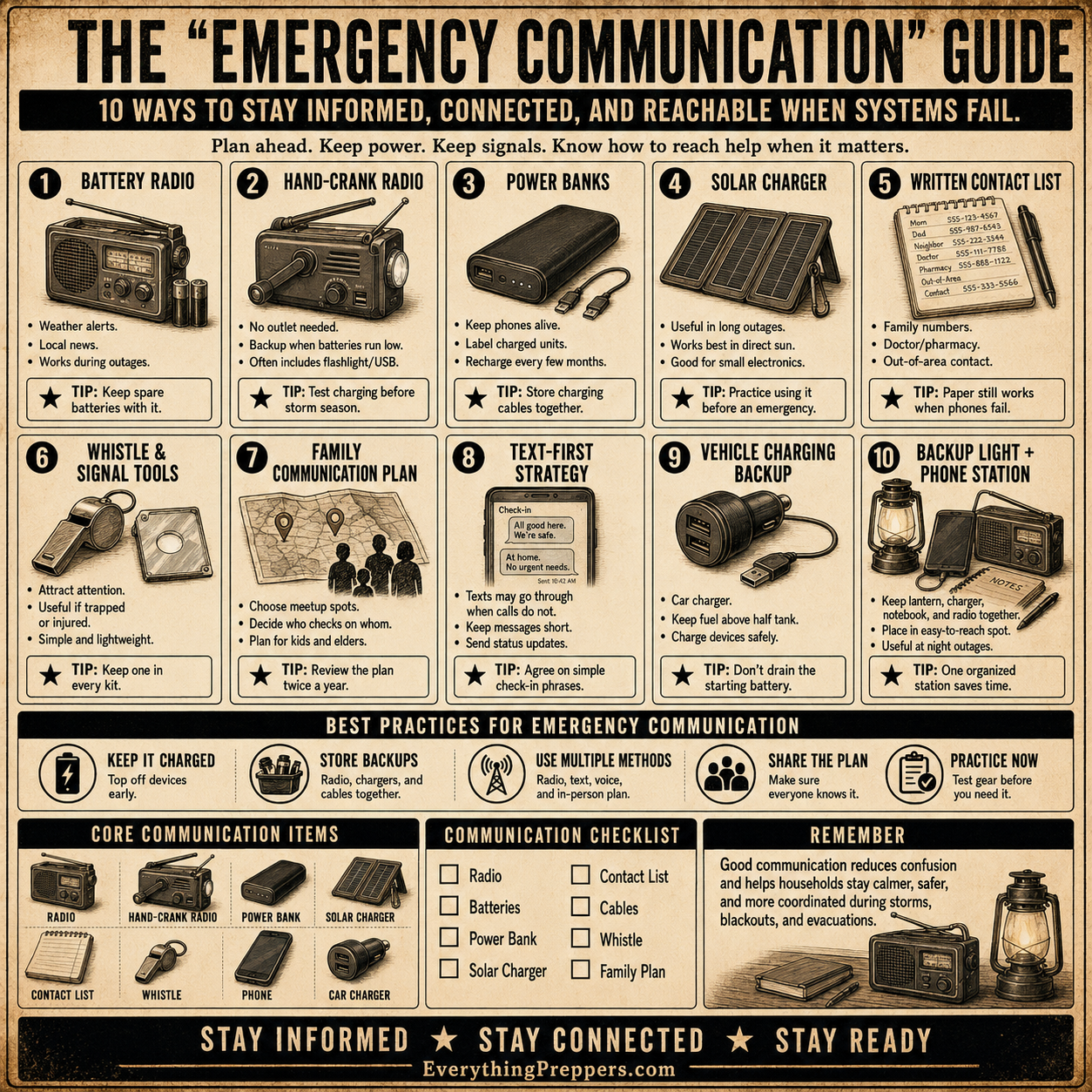
During an emergency, communication can become just as important as food, water, and shelter. A storm, blackout, evacuation, wildfire, flood, or local disruption can make it harder to call family, receive alerts, charge phones, or know what is happening nearby.
That is why every household should have a simple emergency communication plan.
Good communication does not need to be complicated. The goal is to stay informed, keep devices powered, know how to contact family, and have backup methods if phones or internet service become unreliable. With a few basic tools and a clear family plan, you can reduce confusion and respond more calmly when systems fail.
What Is Emergency Communication?
Emergency communication means having a plan and basic tools to receive information, contact family, and ask for help during a crisis.
In normal life, most people depend on smartphones, mobile data, Wi-Fi, and social media. During an emergency, those systems may be slow, overloaded, damaged, or unavailable. A good communication plan gives you backup options.
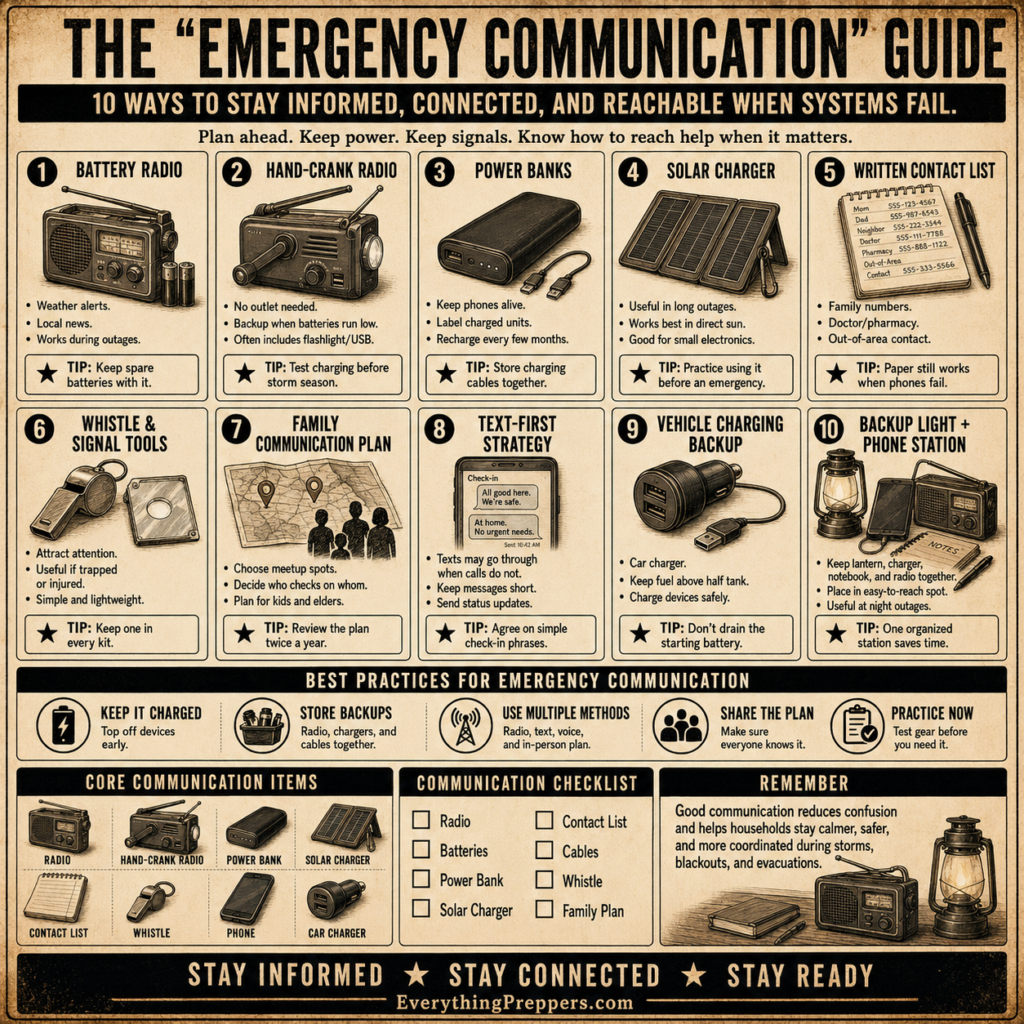
A strong emergency communication setup should include:
- Battery radio
- Hand-crank radio
- Power banks
- Solar charger
- Written contact list
- Whistle or signal tool
- Family communication plan
- Text-first strategy
- Vehicle charging backup
- Organized light and phone station
The best system uses multiple methods instead of depending on only one device.
1. Keep a Battery Radio
A battery-powered radio is one of the most useful emergency communication tools. It can receive local news, weather alerts, public safety updates, and emergency instructions even when internet service is down.
A basic radio can help you monitor:
- Weather warnings
- Local news
- Road closures
- Evacuation notices
- Utility updates
- Public safety information
Store spare batteries with the radio. Do not leave the radio in one place and the batteries in another. During a blackout, you want everything together and easy to find.
Tip: Test your radio before storm season so you know it works and understand how to tune local stations.
2. Add a Hand-Crank Radio
A hand-crank radio is a smart backup because it does not depend only on stored batteries. Many models also include a flashlight, USB charging port, or solar trickle panel.
A hand-crank radio is useful when:
- Batteries run low
- Outages last longer than expected
- You need a backup light
- You want a non-grid information source
However, hand-crank charging is usually slow. Think of it as a backup tool, not your main phone-charging solution.
Tip: Practice using the crank and charging features before an emergency. Some devices work better than others.
3. Store Power Banks
Power banks are one of the easiest ways to keep phones and small devices alive during an outage. They are quiet, portable, and simple to use.
For best results:
- Keep power banks fully charged.
- Recharge them every few months.
- Store charging cables with them.
- Label each power bank if you have several.
- Use them for phones first, not entertainment devices.
A dead power bank is just extra weight. Add a calendar reminder to recharge them regularly.
Tip: Store USB-C, Lightning, and micro-USB cables if your household uses different devices.
4. Use a Solar Charger as a Backup
A small solar charger can be useful during long outages, especially when the weather is sunny and you have no other charging option.
Solar chargers work best:
- In direct sunlight
- During clear weather
- With small electronics
- When angled toward the sun
- When used patiently
Solar charging is weather-dependent. It may be slow on cloudy days, through windows, or in shaded areas. For best results, charge a power bank first, then use the power bank to charge your phone.
Tip: Practice using your solar charger before an emergency so you understand its real performance.
5. Keep a Written Contact List
Phones are convenient, but they are not perfect. If your phone dies, breaks, locks, or loses access to contacts, you may not remember important numbers.
Keep a written contact list that includes:
- Family phone numbers
- Neighbor contacts
- Doctor or clinic number
- Pharmacy number
- School or workplace contacts
- Out-of-area emergency contact
- Insurance or important household contacts
Store one copy in your emergency kit and another in a wallet, bag, or family binder.
Tip: Paper still works when phones fail.
6. Pack a Whistle and Signal Tools
A whistle is small, cheap, lightweight, and useful if you need to attract attention. It can be especially helpful if someone is trapped, injured, lost, or unable to shout loudly.
Other signal tools may include:
- Signal mirror
- Bright flashlight
- Reflective tape
- High-visibility cloth
- Glow sticks
- Small emergency flag
A whistle can be placed in every emergency kit, car kit, backpack, and bedside drawer.
Tip: A whistle is easier to hear over distance than a tired voice.
7. Create a Family Communication Plan
A family communication plan helps everyone know what to do if normal communication fails. This is especially important for households with children, elderly relatives, commuters, or family members in different locations.
Your plan should answer:
- Who checks on whom?
- Where do we meet if home is not safe?
- Who is the out-of-area contact?
- What should kids do if phones fail?
- What should elderly relatives do?
- Where are emergency supplies stored?
- When should we stay home vs. leave?
Choose at least two meetup locations: one near your home and one farther away in case your neighborhood is not accessible.
Tip: Review the plan twice a year so everyone remembers it.
8. Use a Text-First Strategy
During emergencies, phone networks can become overloaded. Calls may fail, but text messages may still go through.
A text-first strategy means sending short, clear messages instead of trying repeated phone calls.
Good emergency texts are simple:
- “I’m safe at home.”
- “Power out, no urgent needs.”
- “Going to aunt’s house.”
- “Need help. At front gate.”
- “Check on grandma.”
Keep messages short. Avoid sending large videos, photos, or long messages when networks are weak.
Tip: Agree on simple check-in phrases with family before an emergency.
9. Prepare Vehicle Charging Backup
A vehicle charger can be useful during longer outages if you can safely access your car. It can help recharge phones, power banks, flashlights, or small electronics.
Useful vehicle charging items include:
- USB car charger
- Charging cables
- 12V adapter
- Small inverter for low-power devices
- Power bank
- Jump starter battery pack
Do not drain your vehicle starting battery. If using your vehicle for charging, follow safe practices and keep enough fuel for actual transportation needs.
Never run a vehicle inside a garage or enclosed space because of carbon monoxide risk.
Tip: Keep your fuel tank above half if severe weather or disruptions are expected.
10. Build a Backup Light and Phone Station
During an outage, scattered gear wastes time. A simple communication station keeps the most important items together in one easy-to-reach place.
Your station can include:
- Lantern
- Radio
- Phone charger
- Power bank
- Notebook
- Pen
- Written contact list
- Spare batteries
- Charging cables
- Whistle
- Small flashlight
Choose a location everyone knows, such as a kitchen shelf, entryway cabinet, bedroom drawer, or emergency tote.
Tip: One organized station saves time when the lights go out.
Best Practices for Emergency Communication
A good communication plan should be simple enough to use under stress.
Follow these best practices:
- Keep devices charged early.
- Store radios, chargers, and cables together.
- Use multiple methods: radio, text, voice, written plan, and in-person meetup.
- Share the plan with every household member.
- Practice before you need it.
- Label chargers and power banks.
- Keep important numbers on paper.
- Test radios and lights monthly.
- Keep backup batteries sealed and organized.
- Update contacts when phone numbers change.
Preparedness works best when everything is easy to find and easy to use.
Core Emergency Communication Items
A basic emergency communication kit may include:
- Battery radio
- Hand-crank radio
- Power bank
- Solar charger
- Written contact list
- Whistle
- Mobile phone
- Car charger
- Charging cables
- Notebook and pen
- Spare batteries
- Small lantern
You do not need to buy everything at once. Start with a radio, power bank, written contact list, and charging cables. Then build from there.
Common Mistakes to Avoid
Mistake 1: Depending Only on a Smartphone
Phones are useful, but they need power and network access. Always have backup tools.
Mistake 2: Forgetting Charging Cables
A full power bank is useless if you do not have the right cable.
Mistake 3: Not Writing Down Phone Numbers
Many people no longer memorize important numbers. Keep a paper list.
Mistake 4: Never Testing the Radio
A radio you do not know how to use can waste time during an emergency. Test it before storm season.
Mistake 5: Sending Long Messages
During network congestion, short text messages are more practical.
Mistake 6: Draining the Car Battery
Vehicle charging can help, but do not drain the battery you may need for transportation.
Safety Notes
Communication tools should support safety, not create new hazards.
Remember:
- Do not run a vehicle in a garage or enclosed space.
- Do not use damaged chargers or swollen power banks.
- Keep batteries away from extreme heat.
- Avoid charging devices near water.
- Follow local emergency alerts and official instructions.
- Keep emergency exits clear while setting up charging stations.
- Do not rely on one single communication method.
- Leave if evacuation is ordered.
If you receive conflicting information, prioritize official local emergency alerts and trusted public safety sources.
How to Practice Your Communication Plan
A plan is stronger when everyone has tested it.
Practice by doing a simple household drill:
- Turn off nonessential lights for 10 minutes.
- Find the emergency communication station.
- Turn on the radio.
- Send a short family check-in text.
- Review your contact list.
- Confirm who checks on pets, kids, or elders.
- Recharge all devices after the drill.
This does not need to be dramatic. A simple practice session helps reveal missing cables, dead batteries, outdated contacts, and confusing instructions.
Final Thoughts
Emergency communication is not about having the most expensive gear. It is about having reliable ways to receive information, contact family, keep devices powered, and reduce confusion when normal systems are stressed.
Start with the basics: a battery radio, power bank, spare batteries, charging cables, written contact list, and a simple family plan. Add a hand-crank radio, solar charger, vehicle charging backup, and signal tools as your kit grows.
The best communication plan is easy to find, easy to use, and shared with everyone in your household.
Plan ahead. Keep power. Keep signals. Know how to reach help when it matters.
Frequently Asked Questions
What is the most important emergency communication tool?
A battery-powered or hand-crank radio is one of the most important tools because it can receive local emergency information when internet service is down.
Should I call or text during an emergency?
Text first when networks are overloaded. Text messages may go through when calls fail, and they use less battery.
Why do I need a written contact list?
If your phone dies, breaks, or loses access to contacts, a paper list gives you important numbers when you need them.
Are solar chargers worth it?
They can be useful during long sunny outages, but they are weather-dependent and often slow. They work best as a backup to power banks.
Can I charge my phone in my car during a blackout?
Yes, but do it safely. Do not run a vehicle in a garage or enclosed space, and do not drain the starting battery.
How often should I test my emergency gear?
Test radios, lights, and chargers at least monthly or before storm season. Recharge power banks every few months.
What should be in a family communication plan?
Include meetup locations, check-in contacts, out-of-area contact, emergency numbers, and who checks on children, elders, and pets.
What should I do if phone service fails completely?
Use a radio for information, follow your family meetup plan, check on nearby trusted neighbors if safe, and use signal tools if you need attention.