PART 1 — THE BOY BEHIND THE SHELVES
My seven-year-old son hid behind the shelves in our basement pantry during a family dinner and whispered, “Dad… am I in trouble for saving the last box?”
Ten minutes later, one small camera clip showed me exactly who had been lying.
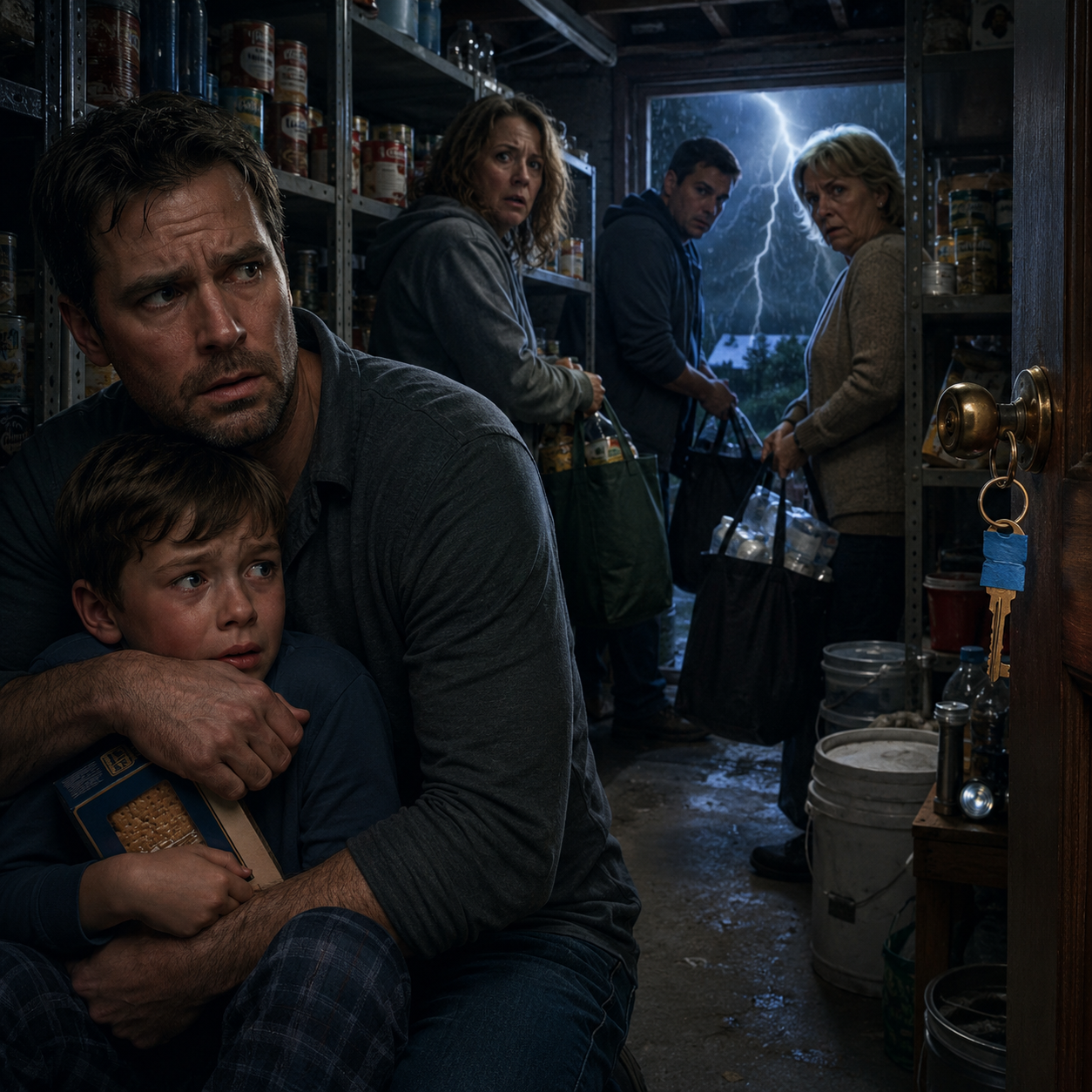
“Dad… did I do something bad?” Noah asked, curled between two five-gallon buckets of rice and a stack of bottled water, his little hands wrapped around a dented box of crackers like it was stolen gold.
Upstairs, my family was still laughing around the dinner table.
My sister Melissa had brought her husband, her two kids, and enough attitude to fill the whole house. My parents were there too. It was supposed to be a simple Sunday dinner, the first one I had hosted in months.
Outside, rain hammered the windows.
The kind of rain that makes the streetlights blur. The kind that makes the power flicker just enough to remind you that comfort is not as permanent as people like to believe.
I had spent almost four years building that basement pantry.
Not some bunker fantasy.
Not a wall full of weapons.
Not a secret doomsday cave.
Just food, water, flashlights, batteries, medicine, a camping stove, a small solar charger, a hand-crank radio, and enough basic supplies to keep my son safe if a storm, blackout, or bad week hit harder than expected.
Every shelf was labeled.
Every bucket was dated.
Every water jug had a rotation sticker.
On the inside of the pantry door, I had taped a simple inventory sheet.
Rice.
Beans.
Oats.
Canned soup.
Peanut butter.
Baby wipes.
Water filters.
First-aid refills.
Emergency snacks for Noah.
That last line mattered more than people understood.
Noah had a nervous stomach when storms got bad. Crackers, peanut butter, and shelf-stable milk were the only things he could eat when anxiety took over.
My family knew that.
They just never cared enough to remember.
Melissa had mocked the pantry since the day she first saw it.
She called it “Daniel’s little apocalypse grocery store.”
My father called it “fear with labels.”
My mother said, “You’ve been different since Claire died.”
And maybe I had been.
Claire was my wife.
Noah’s mother.
She died three years earlier after a sudden brain aneurysm took her from laughing in our kitchen on a Thursday night to gone by Saturday morning.
After that, I learned something most people do not learn until life forces them to.
Nothing is guaranteed.
Not tomorrow.
Not electricity.
Not clean water.
Not the person sleeping beside you.
So yes, I prepared.
Because I had already seen what happens when life changes in one phone call.
And I was not going to let Noah feel helpless if I could prevent it.
That night, dinner had started normally.
My mother brought green bean casserole. Melissa brought store-bought cupcakes and acted like she had baked them herself. My father sat in the recliner and complained that my house was too cold.
Noah sat beside me at the table, quiet as always, gently lining up peas on his plate.
Melissa’s daughter, Sophie, kept asking him why he never talked.
Her older brother Tyler kept poking his arm when adults were not looking.
I noticed.
I always noticed.
“Noah,” I said softly, “you okay?”
He nodded, but his little hand found the hem of my shirt under the table and held on.
My mother saw it and sighed.
“You baby him too much, Daniel.”
Melissa smiled over her wine glass.
“He’s seven. He should be running around with the other kids, not clinging to you like a toddler.”
I looked at Noah’s small hand gripping my shirt.
Then I looked at my sister.
“He’s allowed to be comfortable in his own home.”
That should have ended it.
It did not.
Melissa leaned back and said, “That’s the problem. You’ve made this house feel like a disaster shelter. Kids pick up on fear, you know.”
My father nodded like she had said something wise.
I said nothing.
I had learned that arguing with people who had already decided to misunderstand you was just another way to waste oxygen.
Then the lights flickered.
Once.
Twice.
The children screamed and laughed at the same time.
My mother gasped.
My father said, “Power company better not take all night.”
Then the house went black.
For three full seconds, nobody moved.
Then chairs scraped back.
Phones came out.
Melissa cursed because her glass spilled.
Her husband, Brad, asked if my Wi-Fi was still working.
My father said, “See? This is why I hate storms.”
I stood calmly.
“Everyone stay seated. I have lanterns.”
Melissa laughed in the darkness.
“Of course you do.”
I ignored her and reached for the flashlight I kept in the kitchen drawer.
It was exactly where it was supposed to be.
That small fact made me feel steady.
Preparedness is not about fear.
It is about not losing your mind when the room goes dark.
I turned on the flashlight and looked at Noah’s chair.
Empty.
At first, I thought he had gone to the bathroom.
Then I checked the hallway.
Nothing.
The guest room.
Nothing.
The laundry room.
Nothing.
My voice tightened.
“Noah?”
No answer.
The adults kept talking behind me.
Melissa said, “He probably ran off to cry. Let him.”
I turned toward her slowly.
“What did you say?”
She raised both hands.
“I’m just saying he does that.”
I did not respond.
I went to the basement door.
It was cracked open.
That was wrong.
I always kept it shut during gatherings because the basement stairs were steep and the pantry door stayed locked.
I walked down carefully, flashlight pointed ahead.
The basement smelled like concrete, laundry detergent, and the faint woody smell of cardboard boxes.
At the bottom of the stairs, I stopped.
The pantry door was open.
Not just unlocked.
Open.
My stomach tightened.
The flashlight beam moved across the shelves.
The canned soup shelf was half empty.
The peanut butter was gone.
The powdered milk was gone.
Two water jugs were missing.
The emergency snack bin had been pulled out and left on the floor, its lid hanging crooked from one corner.
Then I heard a tiny sob.
“Noah?”
A small breath caught behind the shelves.
I stepped around the rice buckets and found my son crouched in the corner, knees pulled tight to his chest, cheeks wet, holding one crushed box of crackers against him.
His collar was stretched.
There were red marks on one arm where fingers had gripped too hard.
My whole body went cold.
I knelt slowly.
“Buddy… who did this?”
He shook his head so hard his hair fell into his eyes.
“Please don’t be mad, Dad.”
Those words hurt worse than any scream.
I reached for him, and he flinched.
My son had never flinched from me before.
Not once.
I kept my voice calm, even though something inside me was already shaking.
“Noah, I’m not mad at you. I promise. Tell me what happened.”
He looked toward the pantry door.
Then he whispered, “I tried to stop them.”
“Stop who?”
His lips trembled.
“They said it wasn’t ours.”
I looked at the empty shelf.
Then at the open pantry door.
Then at the lock.
The key was still hanging there.
My breath stopped.
Because that key was not mine.
My pantry key was upstairs on my keychain.
This one had a little strip of blue tape wrapped around the top.
A strip of tape I had not seen in three years.
Not since Claire was alive.
I reached out and touched it.
That key had belonged to my wife.
And after her funeral, I had sealed it in an envelope and given it to my father.
For emergencies only.
I picked Noah up gently.
His arms locked around my neck.
As I carried him upstairs, the flashlight shook in my hand.
Not because I was scared.
Because I already knew.
Someone in that dining room had opened my pantry with Claire’s key.
And whoever it was had put their hands on my son to keep him quiet.
When I reached the kitchen, the talking stopped.
Every face turned toward us.
Melissa stood near the counter with a flashlight in one hand and a jar of my emergency peanut butter in the other.
My mother was holding two cans of soup.
Brad had a reusable shopping bag at his feet.
My father looked at Noah’s face.
Then he looked away.
I asked one question.
“Who opened my pantry?”
No one answered.
Rain beat against the roof.
The house sat in darkness.
And in the beam of my flashlight, every person in my kitchen suddenly looked guilty.
PART 2 — THE CLIP THEY DIDN’T KNOW EXISTED
Melissa was the first one to speak.
“Oh, Daniel, don’t start.”
That sentence told me almost everything.
People who are innocent usually ask what happened.
Guilty people tell you not to react.
I shifted Noah higher on my hip.
His face was buried against my shoulder.
His breathing was uneven.
I looked at the jar in Melissa’s hand.
“Put it down.”
She gave a short laugh.
“It’s peanut butter, Daniel. Not gold bars.”
“It’s emergency food.”
“The power is out.”
“The power has been out for twelve minutes.”
My mother stepped forward, her voice low and sharp.
“Lower your voice. You’re scaring the children.”
I looked down at Noah’s red arm.
“No. Someone already did that.”
The kitchen went silent again.
Brad nudged the reusable bag backward with his foot.
I noticed.
My father noticed that I noticed.
He cleared his throat.
“Son, everyone is tense. The storm, the power outage, the kids getting hungry—”
“Hungry?” I repeated.
Noah’s grip tightened around my neck.
My father avoided my eyes.
Melissa rolled hers.
“Fine. I went downstairs. The kids were scared. Your pantry is full. I took a few things.”
“A few things?”
“You have plenty.”
That was the sentence.
The sentence every unprepared person says right before they help themselves to what someone else worked for.
You have plenty.
As if planning ahead turns your property into a public supply closet.
I looked at my mother.
“You had Claire’s key.”
Her face changed.
Just slightly.
But enough.
My father stepped in quickly.
“I gave it to your mother.”
My chest tightened.
“You what?”
“For emergencies,” he said.
“This was not an emergency.”
“The lights went out,” Melissa snapped. “You were going to act like some pantry police officer while kids sat hungry in the dark?”
“The kids finished dinner fifteen minutes ago.”
Brad finally spoke.
“Man, you’re making this weird.”
I looked at the bag near his foot.
“What’s in the bag, Brad?”
He did not answer.
I stepped forward.
He grabbed it before I could.
That was when Noah lifted his head.
His little voice came out cracked.
“They said they were taking it home.”
Everyone froze.
Melissa’s face hardened.
“Noah, that is not true.”
He shrank against me.
I felt something in me break cleanly in two.
Not loudly.
Quietly.
The way ice splits under weight.
My mother pointed at Noah.
“He misunderstood.”
I looked at her.
“You’re calling my son a liar?”
She took a breath.
“I’m saying he’s sensitive. He always has been.”
Melissa jumped in.
“You’ve trained him to panic over cans and crackers. That’s why he freaked out.”
Noah whispered into my shirt, “I didn’t freak out.”
But nobody listened except me.
My father put on the voice he used when he wanted the room to obey him.
“Daniel, this is family. We can replace food.”
I slowly turned to him.
“You cannot replace trust.”
For the first time that night, he had nothing to say.
Then Melissa made her second mistake.
She pointed toward the basement.
“If you didn’t want people touching that stuff, maybe you shouldn’t hoard it in the first place.”
My mouth went dry.
There it was.
Not borrowing.
Not misunderstanding.
Not concern.
Hoarding.
That word had been used before.
At Christmas.
At Thanksgiving.
In family group chats.
In little jokes that were never really jokes.
I looked at my pantry key hanging from the basement door.
Claire’s key.
The emergency key.
The key I trusted my father to guard.
Then I remembered something.
The raccoon.
Last winter, a raccoon had gotten into the basement through a loose vent screen. It tore open a bag of oats and knocked over two jars. After that, I installed a small motion camera facing the pantry door.
Not because I distrusted people.
Because I distrusted raccoons.
The camera was still there.
Mounted on the beam above the water shelf.
I looked at Melissa.
“You said Noah misunderstood?”
She crossed her arms.
“Yes.”
I nodded.
“Okay.”
I carried Noah to the living room and set him on the couch. I wrapped a blanket around him and put my flashlight beside him.
“Stay here, buddy.”
He grabbed my sleeve.
“Dad, please don’t leave.”
“I’m not leaving. I’m just getting my laptop.”
Melissa’s expression changed.
“What for?”
I did not answer.
I walked to my office, opened my laptop, and connected it to the small battery bank I kept in the drawer.
My hands were steady now.
That scared me more than anger would have.
The family gathered behind me, pretending not to gather.
Melissa whispered something to Brad.
My mother said, “Daniel, this is unnecessary.”
I opened the camera app.
Basement pantry.
Motion events.
The newest clip was twelve minutes long.
I pressed play.
On the screen, the pantry door opened.
Melissa appeared first.
She was carrying her phone flashlight in her mouth and holding Claire’s key.
Brad came behind her with two reusable shopping bags.
Then my mother stepped into frame.
Not confused.
Not surprised.
She pointed directly at the shelf with the powdered milk.
“Take those first,” she said on the clip. “Those are expensive.”
My father made a low sound behind me.
My mother whispered, “Oh, Robert…”
But I kept watching.
Brad loaded cans into the bag.
Melissa took peanut butter.
My mother opened the emergency snack bin.
Then Noah appeared at the bottom of the basement stairs.
Small.
Barefoot.
Holding the railing.
His voice came through the speaker clearly.
“Aunt Melissa, Dad says we only use that when we really need it.”
Melissa turned.
The whole kitchen was silent now.
On the screen, Melissa walked toward him.
“Noah, go upstairs.”
“No. That’s for storms.”
“This is a storm.”
“But you said you’re taking it home.”
Brad looked directly at Melissa.
My mother hissed, “Don’t argue with a child.”
Then Noah stepped between Melissa and the shelf.
He was tiny.
Seven years old.
Standing there in his dinosaur socks, trying to defend the supplies adults had mocked for years.
Melissa grabbed his arm.
Hard.
Noah cried out.
I heard my son make that sound from the laptop speaker, and the room around me disappeared.
On the screen, Melissa bent down close to his face.
“Listen to me, you little brat. Your father has enough. This family needs help, and you are not going to ruin this.”
Noah tried to pull away.
His collar stretched.
The cracker box fell from the shelf.
He grabbed it with both hands and backed into the corner.
Then Melissa looked up and noticed the camera.
Her face changed.
She reached toward it.
The screen went black.
The clip ended.
No one breathed.
For a long moment, the only sound was rain and the hum of the battery bank.
Then Melissa said, “That looks worse than it was.”
I turned toward her.
Noah was on the couch, knees to his chest, staring at the floor.
I looked at my sister.
“You put your hands on my son.”
She lifted her chin.
“He was blocking me.”
“He is seven.”
“He needs discipline.”
The word discipline came out of her mouth like she had any right to use it.
I stood.
Brad moved slightly in front of her.
Bad choice.
I pointed at the door.
“Get out.”
My mother gasped.
“Daniel.”
I did not look at her.
“All of you.”
My father’s face hardened.
“Don’t speak to your mother like that.”
I turned on him.
“You gave away Claire’s key.”
His jaw tightened.
“Your mother asked for it.”
“And you didn’t ask me?”
“She said you would overreact.”
I almost laughed.
Because that was how they worked.
They did something wrong.
Then used my reaction as proof that I was the problem.
Melissa grabbed her coat from the chair.
“Fine. Keep your stupid bunker food.”
But as she moved, something slipped out of her pocket and hit the floor.
A small folded paper.
Brad lunged for it.
Too late.
I picked it up.
It was not a shopping list.
It was not a note.
It was a printed screenshot of my pantry inventory.
My private pantry inventory.
The one taped inside the door.
But this copy had handwritten notes beside it.
Not in Melissa’s handwriting.
In my mother’s.
“Take milk first.”
“Water filters in left bin.”
“Medicine shelf locked?”
“Leave enough so he doesn’t notice right away.”
I looked at my mother.
Her face had gone pale.
And just like that, the night changed again.
Because this was no longer about a blackout.
This was planned.
PART 3 — THE REAL REASON THEY CAME
My mother reached for the paper.
I pulled it back.
“Don’t.”
Her hand froze.
For the first time in my life, my mother looked afraid of me.
Not because I was dangerous.
Because I finally had proof.
Melissa’s face turned red.
“That paper means nothing.”
I looked at the notes again.
“Leave enough so he doesn’t notice right away.”
My voice came out quiet.
“Right away?”
My father closed his eyes.
That told me he knew.
Maybe not all of it.
But enough.
I looked at him.
“How long?”
He said nothing.
“How long have you been using Claire’s key?”
My mother whispered, “Daniel, we were trying to help.”
That word.
Help.
The most dangerous word in the mouth of someone who has already decided they own your life.
I walked to the pantry door and took Claire’s key from the lock.
The blue tape was old. Faded. Peeling at the edge.
Claire had put it there because she always said all keys looked the same in bad lighting.
I remembered her laughing in the garage, holding it up.
“Blue means basement, okay? If the power ever goes out and you lose your keys like you always do, use this one.”
Now it had been used to steal from the child she made me promise to protect.
I looked at my father again.
“How long?”
This time, he answered.
“Six weeks.”
Melissa snapped, “Dad.”
He ignored her.
Maybe guilt finally outweighed loyalty.
Maybe he was tired.
Maybe he knew the paper made denial useless.
My mother turned on him.
“Robert.”
He rubbed his face with both hands.
“I’m done lying.”
The room went completely still.
Noah looked up from the couch.
My father’s voice was low.
“Your mother gave Melissa the key after Labor Day.”
My stomach sank.
Labor Day was six weeks earlier.
The same weekend Melissa had come over with her kids while I was fixing the fence.
The same weekend I noticed three cans missing and blamed myself for miscounting.
My mother stepped forward.
“We only took a few things at first.”
I stared at her.
“At first?”
“Melissa was struggling.”
Melissa’s eyes flashed.
“Mom, stop.”
But my mother kept talking now, maybe because once a lie cracks, people panic and try to explain their way back into innocence.
“Brad’s hours were cut. The kids needed lunches. Groceries are expensive. And you had so much down there.”
I felt my jaw tighten.
“You could have asked me.”
Melissa laughed bitterly.
“You would’ve made us feel small.”
“No,” I said. “You already felt small. That’s why you stole instead.”
Her face twisted.
My mother pointed at me.
“This is exactly why we didn’t tell you. You always turn everything into judgment.”
“You made notes on what to take.”
“We were trying not to upset you.”
“You planned to empty my pantry slowly.”
“We planned to borrow.”
“Borrowing requires permission.”
My mother looked away.
Then Noah spoke.
His small voice cut through the room.
“Grandma said Daddy wouldn’t need all of it if he was normal.”
Nobody moved.
My mother’s eyes widened.
“Noah…”
He shrank under the blanket, but this time he kept talking.
“She said the food made you sad. She said Aunt Melissa was helping clean the bad stuff out.”
My chest tightened so hard I could barely breathe.
I looked at my mother.
She started crying.
Not the kind of crying that comes from remorse.
The kind that comes when someone realizes the story they built around themselves is falling apart.
“I was worried about you,” she said.
“You were stealing from me.”
“You lost Claire and then filled your basement with fear.”
“I filled it with food.”
“You were changing.”
“I became a single father.”
“You stopped trusting people.”
I looked at the bags on the floor.
“You just proved why.”
That silenced her.
Then Brad, who had been quiet too long, grabbed one of the bags.
“We’re leaving.”
“No,” I said.
He stopped.
“You’re emptying the bags first.”
Melissa stared at me.
“You’re serious?”
“Very.”
Brad looked like he wanted to argue, but my father stepped between us.
“Put it back, Brad.”
Brad’s face darkened.
“You don’t get to order me around.”
My father’s voice dropped.
“I said put it back.”
For one second, I saw the old version of him.
The man who taught me how to change a tire.
The man who carried Noah on his shoulders when he was three.
The man I had trusted with Claire’s key.
Then the moment passed.
Brad dumped the bag on the counter.
Cans rolled everywhere.
Peanut butter jars thudded against the wood.
Powdered milk.
Batteries.
Water filters.
Emergency snacks.
And then one more thing fell out.
A small orange bottle.
My hand moved before my brain did.
I picked it up.
Noah’s allergy medicine.
The backup bottle I kept in the pantry because Noah had a severe peanut allergy when he was younger. He had improved, but storms and family gatherings still made me cautious. The medicine was labeled clearly.
NOAH — EMERGENCY BACKUP.
I held it up.
Nobody spoke.
Melissa looked away.
That was when I understood the full truth.
They had not just taken extra food.
They had taken the one thing that could have helped my son in an emergency because it was on a shelf and they believed they had more right to it than he did.
I walked to the front door and opened it.
Rain blew in cold and sharp.
“Get out.”
My mother sobbed.
“Daniel, please.”
I looked at her.
“You used my wife’s key to steal from her son.”
That sentence landed harder than shouting ever could.
My mother covered her mouth.
Melissa grabbed her kids.
Brad carried nothing.
My father stood by the door last.
For a moment, I thought he might apologize.
Instead, he reached into his coat pocket and pulled out a second key.
A duplicate.
Freshly cut.
Silver.
No tape.
He placed it on the entry table.
My blood went cold.
“How many copies did you make?”
He looked at the floor.
“Just that one.”
I did not believe him.
And from the look on his face, he knew it.
Then they left.
The door closed.
The house went quiet except for rain and Noah’s breathing.
The power was still out.
My family was gone.
My pantry was half empty.
And the key I trusted them with had become evidence.
For a long time, I stood in the kitchen holding Claire’s blue-taped key in one hand and the duplicate in the other.
Then Noah whispered, “Dad?”
I turned.
He was standing in the hallway with the blanket around his shoulders.
“Are you mad I saved the crackers?”
I crossed the room and knelt in front of him.
“No, buddy.”
His eyes filled again.
“I didn’t want them to take everything.”
I pulled him into my arms.
“You did the right thing.”
He held onto me tightly.
Then he whispered something that made the hair on the back of my neck rise.
“Dad… there’s another camera.”
I pulled back.
“What?”
Noah pointed toward the basement.
“The little one behind the tool shelf. Mom’s old camera. The one you said didn’t work anymore.”
My heart stopped.
Claire’s old baby monitor camera.
I had forgotten about it.
Years ago, when Noah was a toddler, Claire had used that small camera in the basement play area so she could fold laundry while he played. After she died, I unplugged it.
Or at least, I thought I had.
I went downstairs with Noah behind me, his small hand holding mine.
Behind the tool shelf, covered in dust, the tiny camera still had a blinking blue light.
It had backup battery.
It had recorded.
Not the pantry shelves.
The basement stairs.
The corner Melissa reached after she turned the main camera away.
I took out the memory card and plugged it into my laptop.
The file opened.
At first, it showed darkness.
Then voices.
My mother’s voice.
“Make sure Daniel sees you taking the food. He needs to snap out of it.”
Melissa whispered, “And if he loses it?”
My mother answered, “Then maybe he finally gets help.”
Brad said, “Or maybe he finally understands that this stuff belongs to the family.”
Then my mother said something I will never forget.
“After tonight, he won’t be able to act like Noah is safe here.”
I froze.
Noah’s hand tightened around mine.
Melissa asked, “You really think he’ll let Noah stay with you for a while?”
My mother replied, “If he explodes in front of everyone, he may not have a choice.”
The room tilted.
This was not just theft.
This was not just food.
They had come to provoke me.
They wanted me angry.
They wanted me shouting.
They wanted me to look unstable in front of the children.
And they had used my pantry, my grief, and my son as the trap.
The clip continued.
Noah appeared on the stairs.
He heard them.
That was why he tried to stop them.
Not because of crackers.
Because he understood, in the simple way children sometimes do, that something bigger was happening.
On the screen, Melissa grabbed him.
The collar stretched.
He cried.
My mother said, “Don’t hurt him.”
Melissa snapped, “Then get him out of here.”
Noah pulled free and ran behind the shelves.
Then the clip ended.
I closed the laptop.
My hands were shaking now.
Noah looked up at me.
“Daddy?”
I turned and pulled him close.
“I’m here.”
The power came back at 2:17 in the morning.
The house filled with the hum of the refrigerator, the click of the thermostat, the soft beep of the microwave resetting itself.
Normal sounds.
But nothing felt normal anymore.
By sunrise, I had changed the locks.
By noon, I had moved the pantry camera footage, the second camera clip, the handwritten inventory notes, and both keys into a safe folder.
By evening, I had installed a new lock on the pantry door.
Not because of strangers.
Because of family.
A week later, my mother left a voicemail.
She cried.
She said she was sorry.
She said grief had made me hard.
She said she only wanted to bring the family back together.
I deleted it.
Because family does not steal from a child and call it concern.
Family does not use a dead woman’s key against the son she loved.
Family does not create an emergency just to prove your emergency supplies are unnecessary.
That winter, we had another storm.
A worse one.
Ice coated the roads.
The power went out for thirty-one hours.
Noah and I were fine.
We made soup on the camping stove in the garage with the door cracked open.
We played cards by lantern light.
We checked the battery radio.
We opened the pantry together and took out one box of crackers.
The box he had saved.
I had kept it.
Dented corners and all.
Noah looked at it and smiled a little.
“Emergency crackers,” he said.
I smiled back.
“The most important kind.”
Later that night, while the wind pushed ice against the windows, Noah fell asleep on the couch under two blankets.
I sat beside him with Claire’s blue-taped key in my hand.
I did not keep it on the pantry door anymore.
I put it in a small frame beside her photo.
Not as a key.
As a reminder.
Preparedness is not paranoia.
Sometimes, it is the only thing standing between your child and the people who think love gives them permission to take whatever they want.
And the worst part is not always the storm outside.
Sometimes, it is realizing the real emergency was already sitting at your dinner table.