A power outage can turn ordinary household needs into immediate problems. Refrigerated food begins warming, internet equipment shuts down, phones lose their charge, and essential lights or fans stop working.
Portable power stations provide a quieter alternative to gasoline generators for keeping selected devices running. They combine a rechargeable battery, inverter, charging system, display, and multiple outlets inside one movable unit. Because they do not burn fuel, they produce no engine exhaust during use, although they still require proper ventilation, dry operating conditions, and careful handling.
They are also useful outside emergencies. A compact model can charge cameras and laptops at a campsite, while a larger system can support an RV, refrigerator, power tools, or selected household circuits.
The difficult part is choosing the right size. A 300-watt-hour unit may be perfect for a day trip but disappointing during a two-day blackout. A 4,000-watt-hour station can provide serious home backup, but it may weigh more than 100 pounds and cost significantly more.
This guide compares eight current options across compact, mid-sized, rugged, expandable, and home-backup categories.
Important: Capacities and outlet configurations may differ between 120-volt and 230-volt regional versions. Confirm the specifications, included cables, warranty, and local electrical compatibility before purchasing.
Quick Comparison
| Portable power station | Best for | Battery capacity | Continuous AC output | Approx. weight |
|---|---|---|---|---|
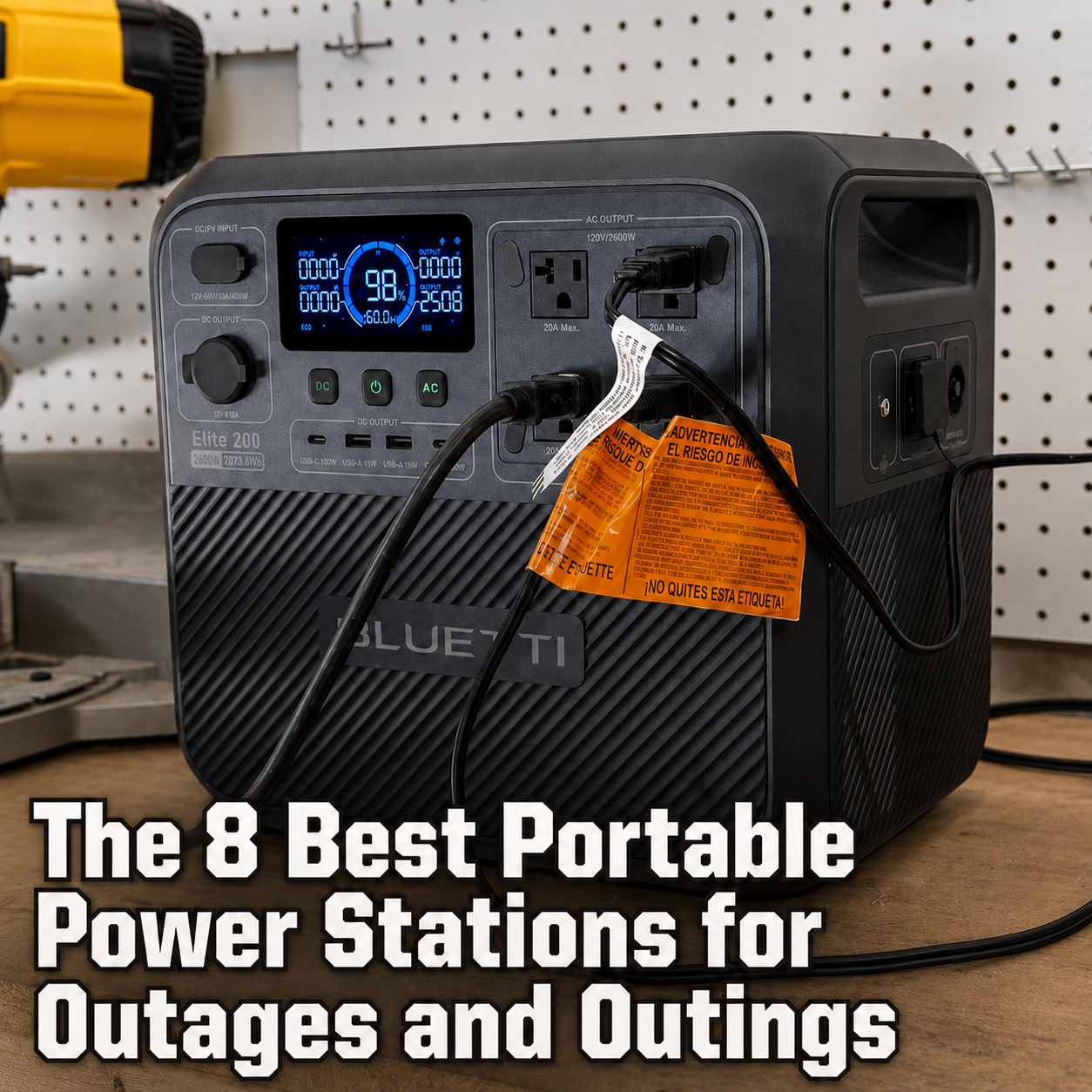
| BLUETTI Elite 200 V2 | Best overall | 2,073.6Wh | 2,600W | 53 lb |
| EcoFlow DELTA 3 Plus | Best 1kWh all-rounder | 1,024Wh | 1,800W | 27.6 lb |
| Jackery Explorer 1000 V2 | Best value | 1,070Wh | 1,500W | 23.8 lb |
| Anker SOLIX C1000 Gen 2 | Best power-to-weight ratio | 1,024Wh | 2,000W | 24.9 lb |
| EcoFlow RIVER 3 Plus | Best compact option | 286Wh | 600W | 10.4 lb |
| Goal Zero Yeti 1500 | Best rugged outdoor model | 1,505Wh | 2,000W | 53 lb |
| BLUETTI Apex 300 | Best expandable system | 2,764.8Wh | 3,840W | 83.8 lb |
| EcoFlow DELTA Pro 3 | Best serious home backup | 4,096Wh | 4,000W | 113.5 lb |
Specifications are based on current manufacturer information and recent independent product testing. (BLUETTI-US)
1. BLUETTI Elite 200 V2 — Best Overall
Key specifications
- Capacity: 2,073.6Wh
- Continuous output: 2,600W
- Peak output: 3,900W
- Battery: LiFePO₄
- Weight: Approximately 53 pounds
- Solar input: Up to 1,000W
- AC outlets: Four on the U.S. version
The BLUETTI Elite 200 V2 occupies a practical middle ground between lightweight camping batteries and extremely heavy home-backup systems. Its 2,073.6Wh battery provides roughly twice the stored energy of a typical 1kWh model, while its 2,600W inverter can handle many refrigerators, microwaves, coffee makers, small power tools, and other demanding appliances within its output limit.
Its capacity makes it especially useful during overnight outages. Instead of using the battery for a single high-draw appliance continuously, owners can rotate essential loads: run the refrigerator periodically, keep the router powered, charge phones, and use efficient LED lighting.
Independent testing by Popular Mechanics found that the Elite 200 V2 delivered approximately 92 percent of its advertised capacity, which was better than the average result reported for many tested power stations. The same test recorded a full AC recharge in less than two hours.
Where it performs best
The Elite 200 V2 is well suited to:
- Refrigerator and freezer backup
- RV and camper use
- Power tools at remote job sites
- Emergency lighting and communications
- Longer camping trips
- Backup for a home office
Its high inverter output is important because capacity and output are different. A battery can contain plenty of energy but still be unable to start a compressor or run a high-wattage appliance if its inverter is too small. The Elite 200 V2 offers both substantial capacity and strong output.
Main limitations
The biggest drawback is expansion. Unlike some modular BLUETTI systems, the Elite 200 V2 is primarily a self-contained unit and does not provide the same broad battery-expansion options as the Apex 300.
At approximately 53 pounds, it is movable but not something most people will want to carry far. It is better suited to a vehicle, garage, RV, workshop, or designated emergency storage area than to hiking.
Verdict
The Elite 200 V2 is the most balanced choice for someone who wants meaningful outage protection without moving into a 100-pound whole-home system. It provides enough capacity for serious emergency use while remaining manageable for one capable adult to move a short distance.
2. EcoFlow DELTA 3 Plus — Best 1kWh All-Rounder
Key specifications
- Capacity: 1,024Wh
- Continuous output: 1,800W
- Surge output: 3,600W
- Battery: LiFePO₄
- Weight: Approximately 27.6 pounds
- AC recharge: Approximately 56 minutes under specified conditions
- Solar input: Up to 1,000W
- UPS transfer time: Under 10 milliseconds
The EcoFlow DELTA 3 Plus is a versatile option for buyers who want a station large enough to operate ordinary appliances but light enough to carry around the house or load into a car.
Its 1,800W output can support a wide range of household equipment, and the 3,600W surge rating helps with appliances that briefly draw extra power when starting. The station also supports compatible expansion batteries, allowing its capacity to grow if your backup needs increase later.
Fast charging is one of its strongest features. EcoFlow advertises a full AC recharge in approximately 56 minutes under the appropriate settings and conditions. Its two solar inputs support up to 1,000W combined, although actual solar performance depends on panel orientation, temperature, clouds, shade, wiring, and available sunlight.
Where it performs best
The DELTA 3 Plus is a practical choice for:
- Short and moderate power outages
- Apartment emergency preparedness
- Refrigerator support
- Remote work
- Car camping
- Photography and video equipment
- Small power tools
- UPS backup for computers and networking equipment
The fast UPS transfer feature can help prevent supported electronics from shutting down during a brief outage. However, consumers should verify that the transfer time and output are appropriate for their specific equipment rather than assuming every device will operate without interruption.
Main limitations
A 1,024Wh battery is substantial but not unlimited. Running a 1,500W heater, hot plate, or electric kettle can consume most of the stored energy quickly. These appliances may operate successfully, but doing so is rarely the most efficient use of emergency battery capacity.
Its 27.6-pound weight is reasonable for a 1kWh station, although it may still be uncomfortable for some users to carry with one hand.
Verdict
The DELTA 3 Plus is one of the strongest general-purpose choices for people who need a combination of fast charging, appliance-capable output, manageable weight, solar compatibility, and future expandability.
3. Jackery Explorer 1000 V2 — Best Value
Key specifications
- Capacity: 1,070Wh
- Continuous output: 1,500W
- Surge output: 3,000W
- Battery: LiFePO₄
- Weight: Approximately 23.8 pounds
- AC outlets: Three
- Solar input: Up to 400W
- Standard AC recharge: Approximately 1.6 hours
The Jackery Explorer 1000 V2 provides a useful combination of capacity, simplicity, and portability. Its 1,070Wh battery is slightly larger than many competing 1kWh stations, yet it weighs only about 23.8 pounds.
The 1,500W inverter is large enough for many refrigerators, televisions, laptops, fans, lights, and kitchen appliances, provided the combined load remains below the unit’s rated limit. It includes three AC outlets, two USB-C outputs, one USB-A port, and a regulated vehicle-style DC outlet.
Jackery also includes an emergency fast-charge mode that can recharge the station much faster than its ordinary charging setting. High-speed charging is useful before a predicted storm, but slower charging modes may be preferable when speed is not necessary because they can reduce noise and charging stress.
Where it performs best
The Explorer 1000 V2 is a good fit for:
- Weekend camping
- Refrigerator backup during shorter outages
- Charging phones, tablets, and laptops
- Running fans and efficient lighting
- Portable internet equipment
- Emergency preparedness in smaller homes
- Users who value a simple interface
Independent testing cited by Popular Mechanics found that the unit powered a large refrigerator for more than 18 hours under its particular test conditions. Actual household results will vary considerably with refrigerator efficiency, room temperature, compressor cycling, food load, and how frequently the door is opened.
Main limitations
The 1,500W inverter offers less headroom than the 1,800W to 2,000W inverters found in several similarly sized competitors. Users planning to operate microwaves, induction burners, tools, or multiple appliances simultaneously must calculate their combined loads carefully.
The 400W maximum solar input is adequate for recreational use but slower than the solar systems supported by the DELTA 3 Plus or BLUETTI Elite 100 and 200 series.
Verdict
The Explorer 1000 V2 is especially attractive when discounted. It offers enough capacity for practical emergency use, weighs less than many competitors, and avoids unnecessary complexity.
4. Anker SOLIX C1000 Gen 2 — Best Power-to-Weight Ratio
Key specifications
- Capacity: 1,024Wh
- Continuous output: 2,000W
- Peak output: 3,000W
- Battery: LiFePO₄
- Weight: Approximately 24.9 pounds
- AC recharge: Approximately 49 minutes
- Solar input: Up to 600W
- UPS transfer time: Approximately 10 milliseconds
The Anker SOLIX C1000 Gen 2 produces an impressive 2,000W of continuous AC output from a station weighing less than 25 pounds. That makes it one of the most portable options for users who occasionally need to run higher-wattage equipment.
It can recharge from empty in approximately 49 minutes using its maximum AC charging mode. It also supports up to 600W of solar input and includes ten output ports on the standard configuration.
This combination is useful for emergency preparedness because a station may need to be charged quickly when a storm warning appears. It can also be moved between the kitchen, home office, vehicle, and campsite without the difficulty associated with 50-pound units.
Where it performs best
The C1000 Gen 2 is particularly suitable for:
- People who need high output in a compact package
- Short blackouts
- Car and tent camping
- Portable cooking appliances used briefly
- Power tools
- Mobile workstations
- UPS support
- Solar-assisted weekend trips
Its 2,000W output does not mean it can run a 2,000W appliance for an hour. After inverter losses and internal consumption, a 1,024Wh battery would provide considerably less than one hour at a constant 2,000W draw.
Main limitations
The station has high output but remains a 1kWh battery. It can operate demanding appliances, but high-wattage use drains it rapidly.
Its 600W solar input is respectable, although lower than the DELTA 3 Plus’s combined maximum. Buyers should also distinguish between the C1000 Gen 2 and retailer-specific variants such as the C1000X Gen 2, which may have different ports or exterior details.
Verdict
The C1000 Gen 2 is ideal for buyers who care more about output, charging speed, and low weight than maximum runtime. It is one of the easiest appliance-capable stations to move around.
5. EcoFlow RIVER 3 Plus — Best Compact Portable Power Station
Key specifications
- Capacity: 286Wh
- Continuous output: 600W
- Surge and X-Boost rating: Up to 1,200W
- Battery: LiFePO₄
- Weight: Approximately 10.4 pounds
- AC outlets: Three on the U.S. model
- USB-C output: Up to 100W
- UPS transfer time: Under 10 milliseconds
The EcoFlow RIVER 3 Plus is intended for a different job than the 1kWh and 2kWh models. It is not designed to carry a household through a long blackout. Instead, it offers useful power in a compact unit that can be carried easily.
Its 286Wh battery can support phones, cameras, laptops, LED lights, routers, fans, small televisions, and other modest loads. The 600W inverter is unusually capable for a station weighing only about 10 pounds.
The base capacity can be expanded to as much as 858Wh with a compatible stackable battery. It also supports UPS operation, making it useful as backup for a modem, router, computer, security equipment, or other compatible electronics.
Where it performs best
The RIVER 3 Plus works well for:
- Day trips and weekend camping
- Camera and drone charging
- Laptop-based remote work
- Internet backup
- LED camp lighting
- Inflating air mattresses
- Small fans
- Emergency communication equipment
It can run some higher-wattage appliances briefly, but its limited battery capacity means those appliances should not be the main reason for buying it.
Main limitations
The small battery is the obvious limitation. A refrigerator, microwave, coffee maker, heater, or cooking appliance can drain it quickly.
It also has only one USB-C port, which may be inconvenient for households with several USB-C laptops, tablets, cameras, or phones.
Verdict
For portability, the RIVER 3 Plus is difficult to beat. It is a strong choice for keeping communications, lighting, and personal electronics running without carrying a large battery.
6. Goal Zero Yeti 1500 — Best Rugged Outdoor Model
Key specifications
- Capacity: 1,505Wh
- Continuous output: 2,000W
- Surge output: 3,600W
- Battery: LiFePO₄
- Weight: Approximately 53 pounds
- Weather rating: IPX4
- Maximum combined solar input: 900W
- Maximum AC charging: 1,500W
The current Goal Zero Yeti 1500 is designed for users who expect their equipment to encounter dust, damp campsites, job sites, and frequent transportation.
Its IPX4 rating provides resistance against splashing water, while covered outlets help protect unused ports. However, IPX4 does not make the station waterproof. It should not be left in rain, submerged, or stored where water can collect around it. (Goal Zero)
The 1,505Wh battery and 2,000W inverter provide enough power for many camping, emergency, and worksite applications. The station supports up to 900W of combined solar input and can recharge from AC power in approximately 1.1 hours at its maximum charging rate.
Where it performs best
The Yeti 1500 is a strong option for:
- Base camps
- Overlanding
- Dusty or damp outdoor environments
- Workshops and job sites
- Emergency household backup
- Field photography and video production
- Users who want covered ports and a robust enclosure
Its selection of AC, USB-C, USB-A, vehicle-style, and Goal Zero high-power connections makes it adaptable to mixed equipment.
Main limitations
At 53 pounds, it is much heavier than most 1kWh models. It is best transported in a vehicle or moved over short distances.
Goal Zero products can also command premium prices. Buyers should decide whether the rugged enclosure and weather resistance justify the additional cost compared with a lighter indoor-oriented station.
Verdict
The Yeti 1500 is the better choice when environmental durability is more important than minimum weight. It is especially appropriate for people who regularly camp, work, or travel in conditions that are hard on equipment.
7. BLUETTI Apex 300 — Best Expandable Power System
Key specifications
- Base capacity: 2,764.8Wh
- Continuous output: 3,840W
- Surge output: 7,680W
- Battery: LiFePO₄
- Weight: Approximately 83.8 pounds
- Voltage output: 120V and 240V on compatible regional versions
- Solar input: Up to 2,400W on the base unit
- Expansion: Supports modular battery and multi-unit configurations
The BLUETTI Apex 300 is more than a large camping battery. It is a modular platform that can begin as a portable station and expand into an RV or home-backup system.
The base unit includes 2,764.8Wh of storage and delivers 3,840W of continuous power. Compatible configurations can provide both 120V and 240V output, allowing the system to support a wider range of equipment than ordinary 120V-only stations. (BLUETTI-US)
Expansion is the Apex 300’s defining feature. Additional BLUETTI batteries and compatible accessories can increase storage substantially. BLUETTI advertises larger configurations extending well beyond the base capacity, although the precise maximum depends on the batteries, hubs, number of Apex units, regional version, and system configuration.
Where it performs best
The Apex 300 is appropriate for:
- RV and travel-trailer systems
- Long outages
- Homestead backup
- Users who plan to add batteries later
- Selected 240V equipment
- High-wattage tools
- Solar-heavy off-grid setups
- Home integration through approved equipment
It accepts up to 2,400W of solar input through its two standard solar channels, making it a serious option for larger solar arrays.
Main limitations
The base unit weighs about 84 pounds. It is movable, but loading it into a tall vehicle may require two people.
The main station also lacks the convenient built-in USB and heavy DC outputs found on ordinary all-in-one units. Those connections require an optional DC hub, adding cost and complexity.
A modular system can become expensive once batteries, solar panels, hubs, transfer equipment, and installation are included.
Verdict
Choose the Apex 300 when expansion matters more than simplicity. It is a strong foundation for an RV, cabin, homestead, or gradually growing backup system.
8. EcoFlow DELTA Pro 3 — Best Serious Home-Backup Option
Key specifications
- Base capacity: 4,096Wh
- Continuous output: 4,000W
- X-Boost output: Up to 6,000W for supported loads
- Battery: LiFePO₄
- Weight: Approximately 113.5 pounds
- Solar input: Up to 2,600W
- Expandable capacity: Depends on battery and system configuration
- Mobility: Integrated wheels and telescoping handle
The DELTA Pro 3 is intended for homeowners, RV users, and preparedness-minded buyers who need more than extension-cord backup for a few small devices.
Its 4,096Wh battery is approximately four times the capacity of a typical 1kWh station. The 4,000W inverter can support several household loads simultaneously, provided their combined running and starting wattage stays within the unit’s limits.
Compatible extra batteries can increase runtime, while approved home-integration equipment can connect the system to selected household circuits. Solar input can reach 2,600W under supported configurations, which gives the system meaningful off-grid recharging potential when paired with a properly designed array.
Where it performs best
The DELTA Pro 3 is designed for:
- Refrigerator and freezer circuits
- Lighting and internet during extended outages
- RV air-conditioning and shore-power applications
- Larger tools and appliances
- Home offices
- Modular home backup
- Solar-assisted emergency power
- Households that want a quieter alternative to routine generator use
Main limitations
The word “portable” must be interpreted generously. At approximately 113.5 pounds, the station is meant to be rolled rather than carried. Stairs, rough terrain, and vehicle loading can be challenging.
Whole-home or critical-circuit operation requires compatible transfer equipment and proper installation. A power station should never be connected to household wiring with an improvised male-to-male cord or any setup that could energize utility lines.
The cost can also rise significantly after adding batteries, panels, inlet equipment, transfer hardware, and professional installation.
Verdict
The DELTA Pro 3 is the strongest option in this list for buyers who want a movable battery that can develop into a substantial household backup system.
Understanding Capacity, Output, and Runtime
Two numbers determine most of a power station’s practical capabilities: watt-hours and watts.
Watt-hours determine runtime
Battery capacity is measured in watt-hours, abbreviated Wh. A 1,000Wh station theoretically contains enough energy to supply 100 watts for 10 hours.
In actual use, some energy is consumed by the inverter, display, cooling system, wiring, and voltage conversion. Independent testing suggests that approximately 85 percent of advertised capacity is a reasonable starting estimate for many AC-powered loads, although efficiency differs by model and load.
Use this formula for a rough estimate:
Estimated runtime = battery capacity × 0.85 ÷ appliance wattage
For example:
1,024Wh × 0.85 ÷ 100W = approximately 8.7 hours
This calculation assumes a constant 100W load. Appliances such as refrigerators cycle on and off, so their average consumption can differ substantially from the wattage shown while the compressor is running.
Watts determine what the station can operate
Output is measured in watts. A station with a 600W inverter cannot continuously run an appliance requiring 1,000W, even when the battery contains enough stored energy.
Add the running wattage of every device you intend to operate simultaneously. Then check starting or surge wattage for equipment containing motors or compressors, including:
- Refrigerators
- Freezers
- Pumps
- Air conditioners
- Power tools
- Blenders
A station should have enough surge capacity to start the appliance and enough continuous output to keep it running.
What Size Portable Power Station Do You Need?
200Wh to 500Wh: Personal electronics and day trips
This range is appropriate for phones, cameras, laptops, LED lights, radios, routers, and short camping trips.
It is easy to transport but generally too small for dependable overnight refrigerator backup.
Approximately 1,000Wh: Short outages and general camping
A 1kWh station is the practical starting point for many households. It can support a refrigerator for a limited period, along with phones, lighting, internet equipment, or a fan.
This size is also manageable enough for one person to carry.
Approximately 2,000Wh: More serious outage protection
A 2kWh station provides more flexibility for refrigerators, freezers, communications, cooking appliances used briefly, and overnight use.
This range is well suited to RVs, workshops, and households that experience outages lasting several hours or longer.
3,000Wh to 5,000Wh: RV and home-circuit backup
Large stations can support multiple appliances and selected household circuits. They are heavy, expensive, and often require wheels, expansion batteries, solar arrays, or transfer equipment.
They should be treated as movable energy-storage systems rather than ordinary camping accessories.
Solar Charging: What to Expect
Solar panels can extend runtime during a prolonged outage, but panel ratings represent ideal laboratory conditions rather than guaranteed real-world production.
A simple theoretical estimate is:
Charging time = battery capacity ÷ solar input
A 1,000Wh station receiving a steady 200W would theoretically require approximately five hours. In practice, conversion losses, clouds, temperature, shade, panel angle, cable losses, and changing sunlight make the recharge time longer.
For emergency preparedness, solar capacity should be sized around average daily energy consumption rather than the station’s maximum input alone. A 1,000W solar input is not useful if you own only one 100W panel.
Portable Power Station Safety
Portable power stations avoid the carbon-monoxide hazard associated with fuel-burning generators, but they remain high-energy electrical devices.
Follow these basic precautions:
- Keep the station dry unless the manufacturer specifically provides an appropriate weather rating.
- Do not block cooling vents or place the unit against curtains, bedding, or other materials that restrict airflow.
- Avoid exceeding the continuous or surge output rating.
- Use undamaged cords with suitable current ratings.
- Keep the station away from excessive heat, open flames, and prolonged direct sun.
- Stop using a unit that is swollen, cracked, leaking, unusually hot, or producing an abnormal odor.
- Use only manufacturer-approved charging cables and compatible solar-panel voltage ranges.
- Never backfeed household wiring through a wall outlet.
- Use an approved transfer switch or inlet system installed according to local codes when powering household circuits.
- Test the complete backup setup before an emergency rather than waiting for an outage.
Fuel-powered generators must be operated outdoors and positioned safely away from buildings because of exhaust and carbon-monoxide risks.
Frequently Asked Questions
Can a portable power station run a refrigerator?
Many 1kWh stations with approximately 1,500W or more of inverter output can start and run an ordinary refrigerator. Runtime varies with refrigerator efficiency, ambient temperature, compressor surge, door openings, and other connected loads.
For longer outages, a 2kWh station provides a more comfortable reserve.
Can one run an electric heater?
A high-output power station may run a portable heater, but most heaters draw approximately 1,500W continuously. That can drain a 1kWh station in well under an hour and a 2kWh station in roughly an hour to a little over an hour after losses.
Heating people with blankets, insulated clothing, sleeping bags, or heated bedding operated intermittently is usually a more efficient use of limited battery energy.
Are portable power stations safe to use inside?
Unlike gasoline, diesel, or propane generators, battery power stations do not create combustion exhaust during normal operation. They are commonly used indoors, but they must still be kept dry, ventilated, undamaged, and operated according to the manual.
What is the difference between a power station and a solar generator?
The power station is the battery and inverter unit. The term “solar generator” usually describes a portable power station sold or used with solar panels.
Solar panels generate the electricity, while the battery stores it for later use.
Can a power station remain plugged in as a UPS?
Some models support pass-through power and automatic UPS operation. Others have limitations on long-term pass-through charging or transfer speed.
Only use this feature when the manufacturer specifically supports it, and test the connected equipment before relying on it.
How should a power station be stored?
Follow the model’s manual because storage recommendations differ. In general, store the station in a cool, dry area, protect it from extreme temperatures, inspect it periodically, and recharge it according to the manufacturer’s recommended schedule.
Do not place it in a forgotten corner for several years and assume it will be ready during an emergency.
Final Recommendation
For most households wanting meaningful outage protection, the BLUETTI Elite 200 V2 offers the strongest balance of capacity, appliance output, recharge speed, and manageable size.
The EcoFlow DELTA 3 Plus, Jackery Explorer 1000 V2, and Anker SOLIX C1000 Gen 2 are better choices when lower weight and easier transportation matter more than maximum runtime.
The EcoFlow RIVER 3 Plus is the most practical compact option for communication, lighting, laptops, and short outdoor trips.
For rugged environments, the weather-resistant Goal Zero Yeti 1500 stands out. Buyers planning a modular RV, homestead, or home-backup system should consider the BLUETTI Apex 300 or EcoFlow DELTA Pro 3.
The best power station is not necessarily the one with the largest battery. It is the one that can start your essential appliances, run them for the required period, recharge through methods available to you, and remain portable enough to use when the power actually goes out.