My twelve-year-old son woke me at 2:13 in the morning and whispered, “Dad… someone is draining our emergency water.”
At first, I thought he had dreamed it.
Then I heard the slow scrape of plastic against concrete outside the kitchen window.
The city had been without running water for four days.
A chemical spill upstream had contaminated the treatment plant. Officials kept promising bottled-water deliveries, but every announcement was followed by another delay.
Stores had been stripped bare.
People were filling bathtubs with melted ice.
Two men had been arrested for fighting over the last case of water at a gas station.
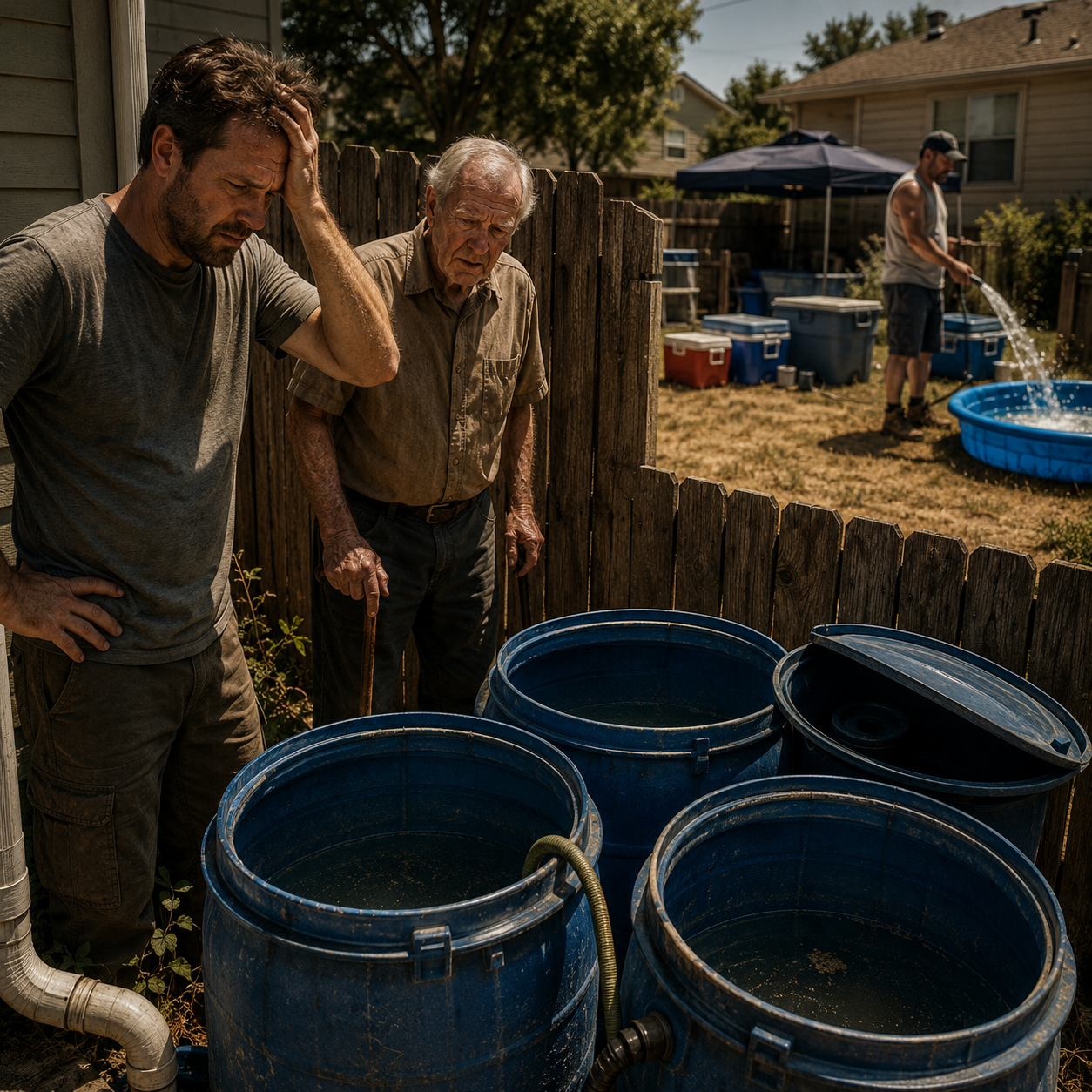
But my family had three blue barrels behind the garage.
One hundred and sixty-five gallons.
Enough to keep my wife, my son, my eight-year-old daughter and me drinking for several weeks if we were careful.
I reached for the flashlight beside the bed.
My son grabbed my wrist.
“Don’t turn it on,” he whispered.
His face looked pale in the moonlight.
“He’ll know we saw him.”
The Hose Through the Fence
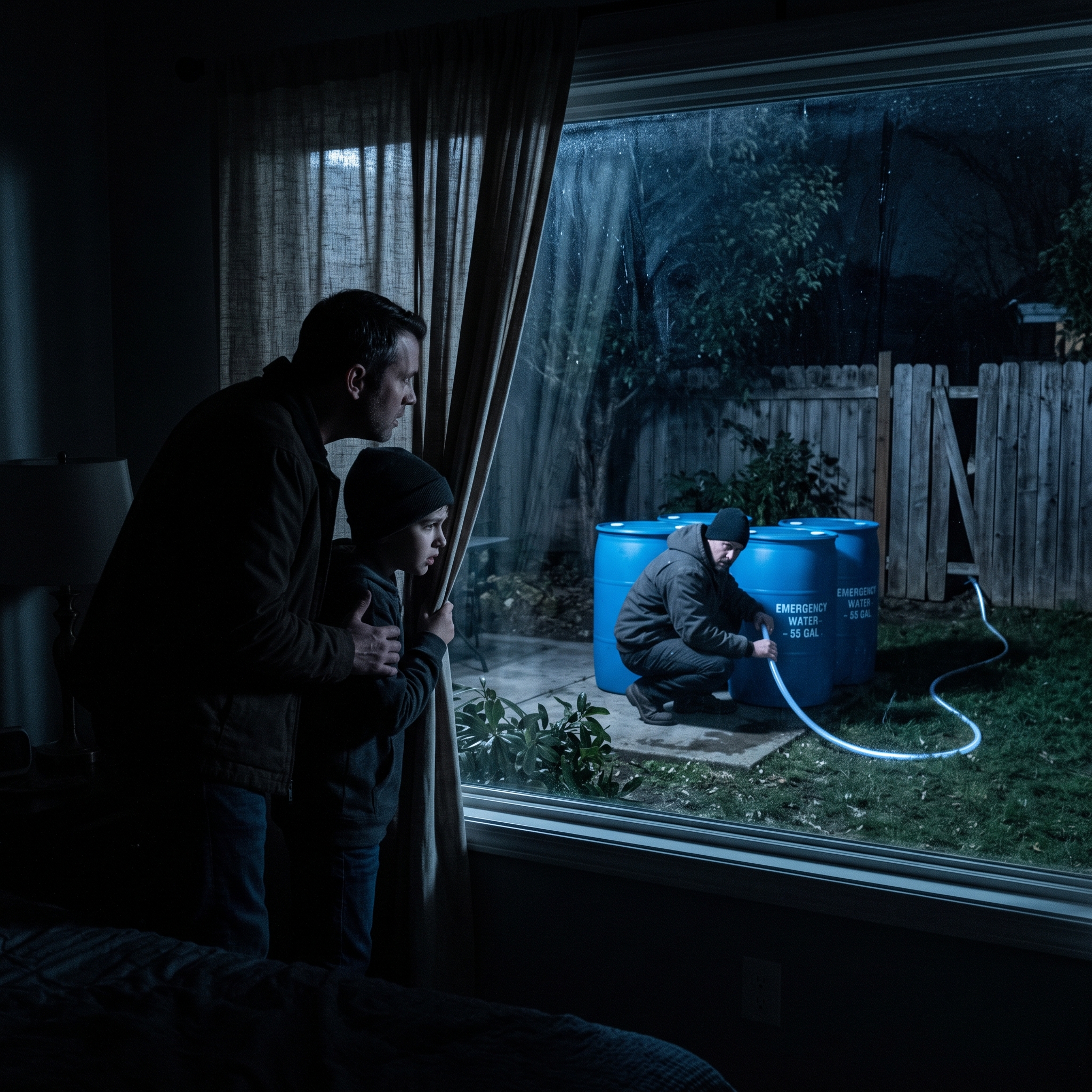
I pulled back the curtain.
A man in a dark work jacket crouched beside the largest barrel.
He had fed a clear hose beneath the fence and was siphoning water into the neighboring yard.
I recognized the jacket immediately.
It belonged to my younger brother, Nathan.
The same brother who had spent years mocking my emergency supplies.
Whenever he visited, he called the garage my “end-of-the-world museum.”
He laughed at the water barrels.
He laughed at the filters.
He laughed when I dated every container and replaced the water twice a year.
“You know faucets exist, right?” he used to say.
Now he was stealing from one.
I started toward the back door.
My son stopped me again.
“Dad, he isn’t taking it to his house.”
He handed me the small binoculars we kept near the window.
I followed the hose across the neighboring property.
It disappeared behind an abandoned delivery van parked beside an empty house.
The rear doors were open.
Inside were dozens of plastic containers.
Some were new.
Others had handwritten addresses taped to them.
Standing beside the van was a man wearing a reflective city emergency-management vest.
I knew him.
Everyone in the neighborhood did.
His name was Dennis Ward.
That morning, he had appeared on television and announced that our district’s emergency water delivery had been canceled because the shipment had been redirected to a hospital.
Nathan handed him another full container.
Dennis gave him an envelope.
Six Years of Being Laughed At
I began storing water after the summer blackout of 2020.
The power failure lasted only fourteen hours, but the pumps at our local water station stopped.
By evening, grocery shelves were empty.
Our daughter, Emily, was only two.
She developed a fever that night.
We had barely enough bottled water to mix her medicine and keep her hydrated.
My wife, Laura, sat beside her bed holding a damp cloth against her forehead.
“We should never be this helpless again,” she said.
So I learned.
I bought food-grade containers.
I built raised wooden platforms so the barrels would not sit directly on concrete.
I installed a first-flush diverter on the rain collection system.
I bought filters capable of handling bacteria and sediment.
I stored purification tablets as a backup.
At first, Laura supported me.
Then the emergency passed.
The years stayed quiet.
The barrels became background scenery.
Nathan’s jokes became louder.
At family cookouts, he would point toward the garage and tell people I was preparing for civilization to collapse.
I stopped defending myself.
Preparation did not require anyone’s approval.
It only required doing the work before the need arrived.
The Chemical Spill
The first alert came at 6:42 on a Tuesday morning.
A tanker truck had overturned near the river.
Residents were told not to drink, cook with, or bathe in tap water.
Boiling would not make it safe.
By noon, every store within thirty miles had sold out.
The city established distribution points.
Then trucks failed to arrive.
Officials blamed traffic.
Then inventory errors.
Then “unexpected regional demand.”
On the third day, Dennis Ward announced that households would receive water by neighborhood.
Ours was scheduled for Friday.
Friday came.
No truck.
Dennis stood in front of a camera and explained that the delivery had been diverted.
People believed him because they had no choice.
Nathan at the Door
I did not confront him beside the van.
I waited until morning.
At seven, Nathan appeared at our front door as though nothing had happened.
He carried two empty grocery bags.
“Any chance you can spare some water?” he asked.
I looked at him.
His hair was damp.
Not sweaty.
Washed.
His clothes were clean.
Everyone else in the neighborhood had been using baby wipes and rationing every cup.
“You already took some,” I said.
His expression changed.
Only for a second.
Then he smiled.
“What are you talking about?”
“At two this morning.”
The smile disappeared.
Behind me, Laura stepped into the hallway.
Nathan looked past me toward her.
“You watched me?”
“My son did.”
He lowered his voice.
“Can we talk outside?”
“No.”
“Daniel, please.”
My name is Daniel Mercer.
Nathan had never called me Daniel unless he was afraid.
The Explanation
He said Dennis had approached him two days earlier.
Dennis knew Nathan had once worked for a bottled-drink distributor.
He offered him cash to collect water from residents who had private supplies.
“What residents?” I asked.
Nathan looked at the floor.
“People who have more than they need.”
“You mean people you decided had more than they needed.”
“He said it was for medical cases.”
“Then why did he pay you?”
Nathan did not answer.
Laura folded her arms.
“How much water have you taken?”
“Not much.”
“How much?”
He hesitated.
“Maybe four hundred gallons.”
My stomach tightened.
“You stole four hundred gallons from this neighborhood?”
“Dennis said the city would replace it.”
“Where is it going?”
“To people who need it.”
“Show me.”
“I can’t.”
“Then leave.”
Nathan’s face hardened.
“You have more water than anyone on this street.”
“That does not make it yours.”
“You would let families go thirsty while those barrels sit behind your garage?”
“We have two children.”
“So does everyone else.”
“You could have asked.”
He looked at me for a long moment.
Then he said, “You would have said no.”
That hurt more than the theft.
Because he believed it.
The Address Labels
After Nathan left, my son brought me something.
He had gone outside after sunrise and found it beside the fence.
A wet paper label.
An address was written across it.
1147 North Harper Street.
Laura searched the address on her phone.
It belonged to a private gym.
Not a hospital.
Not a care home.
Not an emergency shelter.
A gym.
The owner was Dennis Ward’s brother-in-law.
I called the police.
The dispatcher said they were overwhelmed and could not investigate a stolen-water complaint immediately.
I called the city.
No one answered.
Then my neighbor, Mrs. Ortega, knocked on the door.
She was seventy-six and used a portable oxygen concentrator.
Her emergency bottles were almost empty.
She had planned to refill them at a clinic, but the clinic had closed because it had no safe water.
“I heard you might have extra,” she said quietly.
Nathan had been right about one thing.
People needed help.
But stealing from prepared households and selling the water was not help.
It was exploitation.
The Neighborhood Meeting
That afternoon, I placed a folding table in my driveway.
On it, I put a five-gallon container, measuring cups and a notebook.
I offered each household two gallons.
Not enough for bathing.
Not enough for laundry.
Enough for drinking and basic medicine until we found another source.
Twenty-three families came.
Some apologized.
Some cried.
One man offered me fifty dollars.
I refused.
When Mrs. Ortega arrived, my son carried her water home.
Nathan watched from across the street.
He did not come over.
By sunset, one barrel was nearly empty.
Laura stood beside me.
“How long can we keep doing this?”
“Not long.”
“What happens when it’s gone?”
I looked toward the abandoned delivery van.
“We find out where ours went.”
The Gym
At midnight, Nathan returned.
This time, he did not knock.
He stood beneath the porch light with blood on his lip.
“Dennis knows you found the label,” he said.
“What happened?”
“He thinks I kept one of the envelopes.”
“Did you?”
Nathan reached inside his jacket and handed me a folded sheet of paper.
It listed twelve private customers.
Restaurants.
Construction companies.
A luxury apartment complex.
The gym.
Each had paid for water that city records claimed had been delivered to emergency sites.
Dennis had been diverting public shipments and supplementing them with stolen household supplies.
“How long?” I asked.
“Since the second day.”
“Why did you help him?”
Nathan looked toward the dark street.
“Because I owed money.”
He had lost his job three months earlier.
He had not told us.
His rent was overdue.
His car was close to repossession.
Dennis offered him cash.
“At first, I believed the water was going to nursing homes,” he said. “Then I saw the payments.”
“And you continued.”
“Yes.”
His voice broke.
“I kept telling myself I would stop after one more night.”
The Last Full Barrel
We had forty-eight gallons left.
The forecast predicted another week before the water plant reopened.
Nathan wanted to go to the police.
I told him we needed evidence.
The next morning, he texted Dennis and offered him our final barrel.
Dennis arrived after dark.
He backed the van into the alley.
My son recorded from the upstairs window.
Laura filmed from the kitchen.
I stood beside the barrel.
Dennis handed Nathan a stack of cash.
Then he saw me.
For several seconds, no one moved.
“You’re interfering with emergency operations,” Dennis said.
“You canceled our delivery.”
“It was redirected.”
“To your brother-in-law’s gym?”
His expression changed.
Nathan held up the payment list.
Dennis lunged toward him.
That was when the headlights appeared.
Three police cruisers entered the alley.
Mrs. Ortega had called an officer she knew from church and told him there was a city vehicle stealing emergency water.
The officer had taken her seriously.
What They Found
The gym contained more than eight thousand gallons.
Some had come from municipal shipments.
Some had come from private wells.
Some had been stolen from homes.
Dennis had been selling access by membership level.
Premium members could shower.
Businesses could purchase bulk containers.
One restaurant had paid nearly four thousand dollars.
Emergency shelters received almost nothing.
Dennis was arrested.
Two other city employees were suspended.
Nathan was charged with theft and later accepted a plea agreement that required restitution and community service.
He did not ask me to defend him.
He only asked that I tell the truth.
So I did.
The Rain
Three days later, rain began falling.
Not a storm.
Just a steady summer rain.
The neighborhood gathered beside my garage.
We stretched clean tarps over folding frames and directed runoff into sanitized containers.
I showed everyone how to discard the first dirty water.
How to filter sediment.
How to disinfect water safely.
How to label containers with collection dates.
Nathan stood at the edge of the group.
His lip was still bruised.
No one spoke to him at first.
Then Mrs. Ortega handed him an empty bucket.
“Standing there won’t fill this,” she said.
He took it.
For the next four hours, he carried water to elderly residents.
The New Plan
After the crisis, our neighborhood created a shared emergency-water plan.
Households stored what they could.
People with larger properties installed rain systems.
We recorded who had infants, medical needs or limited mobility.
No one was forced to share.
No one’s supplies were treated as public property.
But we agreed that emergencies should not begin with strangers knocking on doors and guessing who might help.
Nathan attended every meeting.
He never joked about my barrels again.
The Blue Container
A year later, on the anniversary of the spill, Nathan arrived with a new fifty-five-gallon barrel.
He had saved for months.
On the side, he had written:
FOR THE MERCER STREET EMERGENCY RESERVE
“I know it doesn’t replace what I took,” he said.
“No.”
“I know trusting me again will take longer.”
“Yes.”
He looked at my son.
“I’m sorry you had to see me that night.”
My son did not answer immediately.
Then he handed Nathan a permanent marker.
“You forgot the date,” he said.
Nathan wrote the fill date beneath the label.
Together, they moved the barrel onto its platform.
What Preparation Means
For years, people thought preparing meant expecting the worst from the world.
Stocking water.
Storing food.
Planning for systems to fail.
But the chemical spill taught me something different.
Preparation is not about believing everyone will become your enemy.
It is about making sure fear does not get to decide who you become.
We had stored water to protect our family.
When the emergency arrived, that water protected more than us.
It protected Mrs. Ortega.
It exposed a crime.
It gave our neighborhood time to organize.
And eventually, it gave my brother a way to begin repairing what he had broken.
I still check the barrels twice a month.
My son checks the labels.
Nathan helps rotate the water every six months.
The largest barrel stands beside the fence where the hose once disappeared into the darkness.
The scrape marks are still visible near the valve.
I could replace it.
I have chosen not to.
Some damage should be repaired.
Other damage should remain where you can see it.
Not as proof that someone failed.
As a reminder that the next decision can still be different.