My seven-year-old son hid behind the shelves in our basement pantry during a family dinner and whispered, “Dad… am I in trouble for saving the last box?”
Ten minutes later, one small camera clip showed everyone exactly who had been lying.
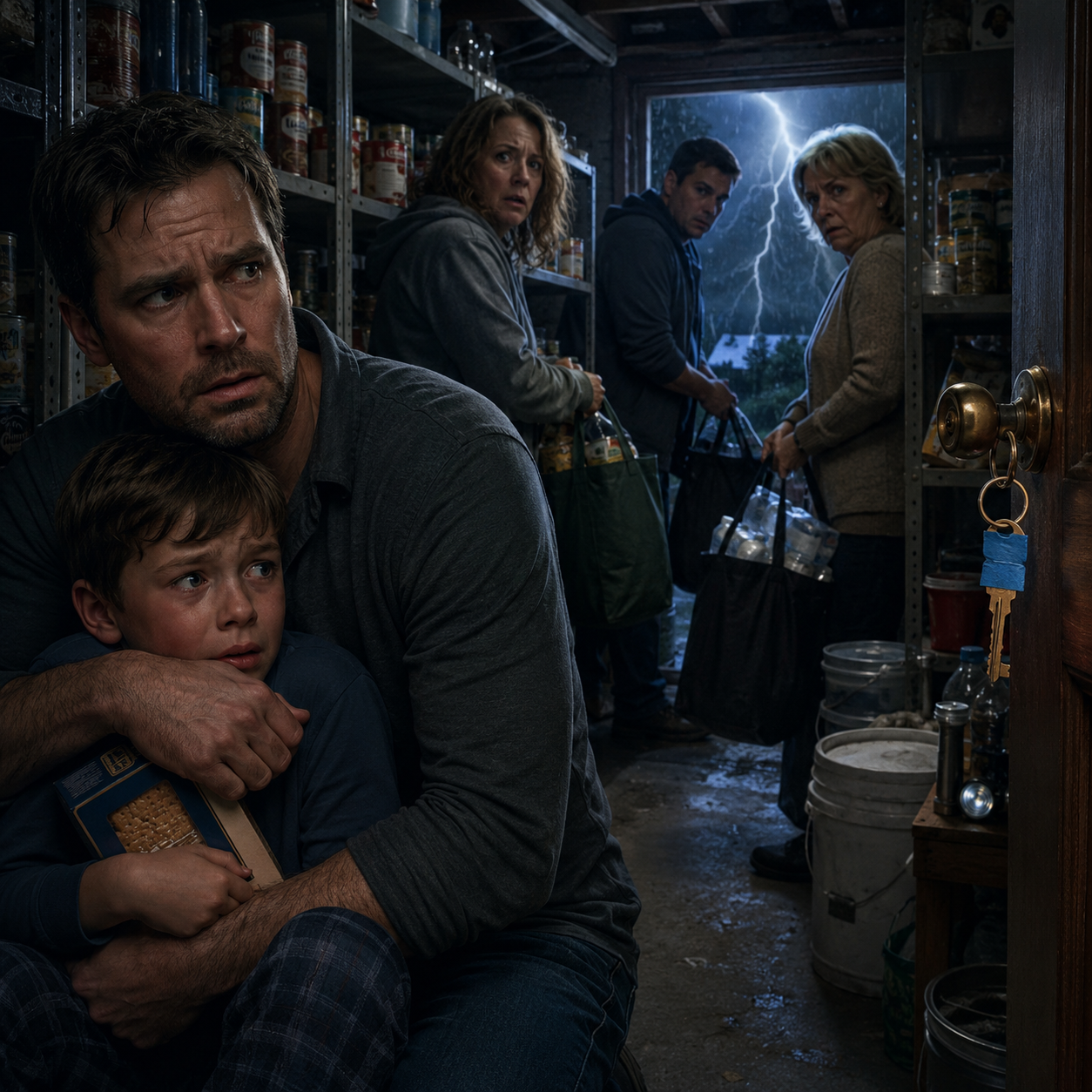
“Dad… did I do something bad?” Noah asked, curled between two buckets of rice and a stack of bottled water, his little hands wrapped around a dented box of crackers like it was something stolen.
Upstairs, my family was still laughing around the dinner table.
My sister Melissa had brought her husband and kids over. My parents were there too. It was supposed to be a simple Sunday dinner, the first one in months. Outside, heavy rain slapped against the windows, the kind of rain that turns streets shiny and makes the lights flicker just enough to remind you how fragile everything is.
I had spent years building that basement pantry.
Not some bunker fantasy. Not doomsday nonsense. Just food, water, batteries, medicine, flashlights, a small solar charger, a camping stove, and enough supplies to get my son through a bad week if the world outside decided not to cooperate.
My family never understood it.
Melissa called it “your little apocalypse museum.”
My father said, “Back in my day, people didn’t need shelves full of beans to feel like men.”
My mother smiled every time and said, “You’re just anxious since the divorce.”
Maybe I was anxious.
After Noah’s mother left, I became the only person standing between my son and whatever happened next. So yes, I stored food. I labeled water. I checked batteries. I kept a paper inventory taped inside the pantry door.
Because promises are not supplies.
And love does not boil water when the power is out.
That night, after dinner, the lights snapped off.
The whole house went black.
The children screamed first. Then the adults started talking over each other. My mother called for candles. Melissa complained about the Wi-Fi. My father said the power company would fix it in twenty minutes.
I went straight to the basement.
Flashlights were on the second shelf. Lanterns were in the blue bin. Battery radio in the clear tote.
But when I opened the pantry door, I froze.
Half the shelf was empty.
Not messy.
Empty.
The canned soup was gone. The peanut butter was gone. The emergency snack box was ripped open. A five-gallon water jug was missing from the floor.
Then I heard Noah crying behind the shelves.
I found him crouched in the corner, holding the last unopened box of crackers.
His cheek was wet. His shirt was stretched at the collar.
“Who touched you?” I asked.
He shook his head.
“I didn’t want them to take all of it,” he whispered. “You said this was for emergencies.”
My chest went cold.
I carried him upstairs with the flashlight in one hand and the crackers in the other.
The room went quiet the moment they saw his face.
Melissa stood near the kitchen island with her arms crossed.
Her oldest son was eating peanut butter straight from one of my emergency jars.
My mother looked away.
My father took a slow breath and said, “Don’t start.”
I looked at Melissa.
“Why is my pantry empty?”
She laughed like I had embarrassed her.
“Your pantry? Daniel, it’s food. You have enough down there to feed a small army.”
“That food is for emergencies.”
“This is an emergency,” she snapped. “The power is out.”
“The power has been out for eleven minutes.”
My mother stepped between us.
“Please don’t make this ugly. The kids were hungry.”
“Noah was crying in the basement.”
Melissa rolled her eyes.
“He got dramatic because I told him sharing is important.”
Noah buried his face in my shirt.
I felt his fingers shaking.
My father lowered his voice.
“You’ve been teaching that boy fear. That’s why he reacted like that.”
Something inside me went very still.
For years, I had let them laugh.
I let them call me paranoid. I let them mock the shelves, the labels, the water rotation chart, the little notebook where I tracked expiration dates.
But now my son was trembling in my arms while they stood in my kitchen eating the food I had saved to protect him.
Then Melissa made her mistake.
She pointed at Noah and said, “He was the one hiding food, not me.”
I looked toward the basement door.
Then I remembered the small motion camera I had installed after a raccoon got in through the side vent last winter.
It faced the pantry shelves.
It recorded every time the door opened.
I set Noah down gently on the couch, walked to my desk, opened my laptop, and pulled up the footage.
Nobody moved.
On the screen, Melissa appeared first.
She opened the pantry door with a flashlight, looked over her shoulder, and waved her husband down the stairs.
Then my mother came in behind them carrying reusable shopping bags.
One by one, they filled the bags.
Canned food.
Batteries.
Water filters.
Medicine.
Even the children’s emergency snacks.
Then Noah appeared in the frame, small and scared, standing in his socks at the bottom of the stairs.
The camera caught his voice clearly.
“Aunt Melissa, Dad said we only use that when we really need it.”
Melissa turned around.
And in front of everyone, on my laptop screen, she grabbed the collar of his shirt and hissed:
“Your father is selfish. Don’t you dare tell him.”
The kitchen went silent.
My mother covered her mouth.
My father looked at the floor.
Melissa’s face changed from angry to pale.
I closed the laptop.
Then I picked up my keys.
“Dinner is over,” I said.
Melissa tried to speak, but I raised one hand.
“No. You don’t get to call me paranoid while stealing from the supplies you mocked. You don’t get to scare my son in his own home. And you don’t get to decide that my preparedness belongs to you because you refused to prepare.”
Outside, thunder rolled across the neighborhood.
The power stayed off for nine hours.
But for the first time in years, my house felt safer with my family outside of it.