An earthquake can interrupt electricity, water, phone service, transportation, medical access, and grocery deliveries within seconds.
The shaking may last less than a minute, but the disruption can continue for days. Broken glass, fallen furniture, damaged utility lines, blocked roads, fires, and repeated aftershocks can make ordinary tasks much more difficult.
A practical earthquake kit should help your household handle four immediate priorities:
- Avoid injuries after the shaking.
- Treat minor injuries while professional help is delayed.
- Maintain water, food, lighting, and communication.
- Respond safely to fire, dust, debris, and damaged utilities.
CDC recommends preparing enough emergency supplies to last at least three days. Earthquake planning should also include securing heavy objects, practicing Drop, Cover, and Hold On, identifying utility shutoffs, and creating a household communication and evacuation plan. (CDC)
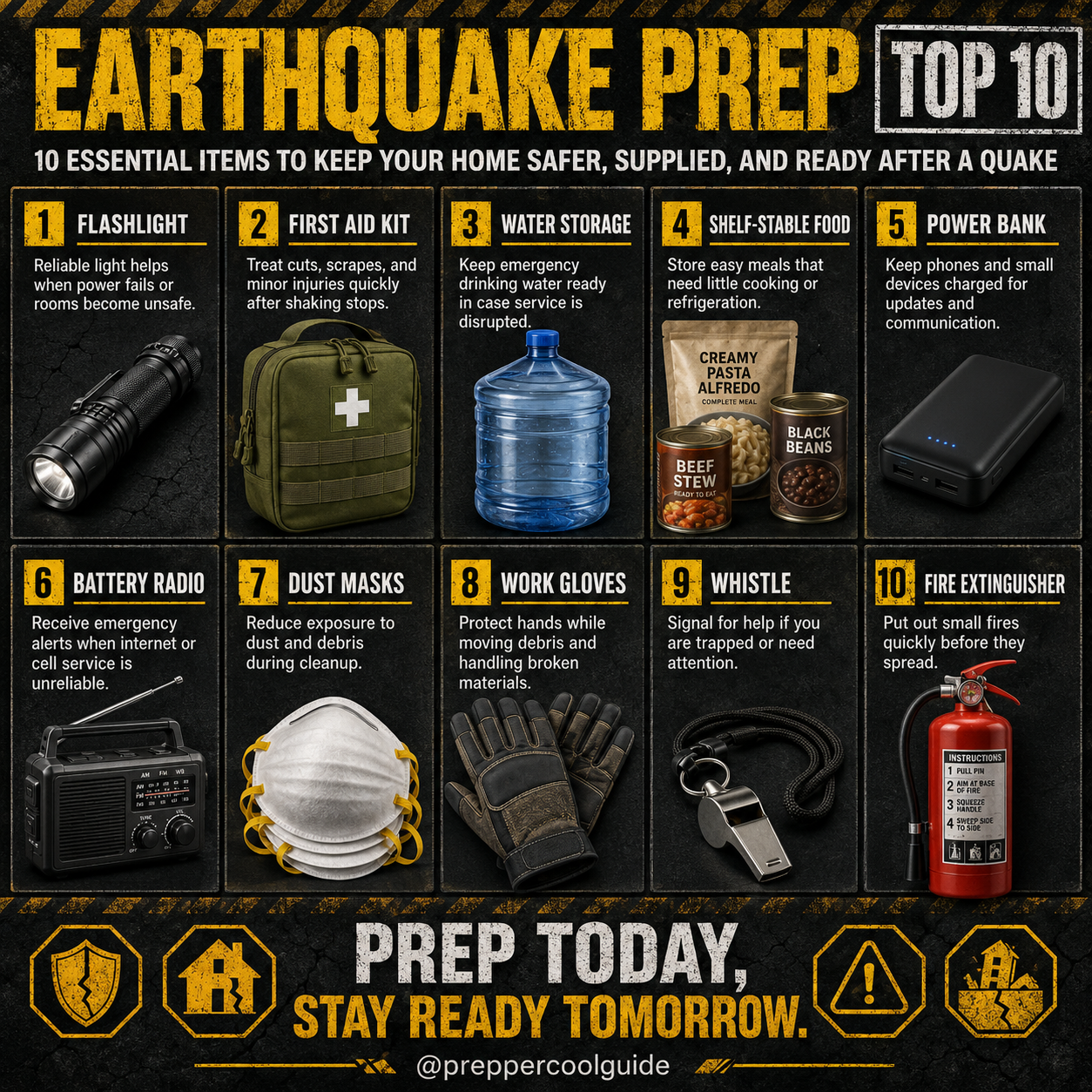
The ten items in the featured image form a strong starter kit, but they work best when carefully selected, stored, and practiced with before an emergency.
Three Important Improvements to the Featured List
The infographic is useful, but three details deserve clarification.
Store water in more than one container
A single large jug is difficult to move and creates one point of failure. A damaged cap, cracked container, or contaminated storage location could affect the entire supply.
Divide drinking water among several durable containers and store them in more than one accessible location.
Upgrade basic dust masks when possible
For dusty cleanup work, a NIOSH-approved N95 respirator provides better particulate protection than a loose nuisance-dust mask. It must fit closely to the face to work properly, and it will not protect against carbon monoxide, natural gas, chemical vapors, or oxygen-deficient air. (CDC)
Use a fire extinguisher only when escape is still safe
An extinguisher is meant for a small, contained fire. Evacuate instead when smoke is heavy, the fire is spreading, you lack a clear exit, or you are uncertain about your ability to control it. (U.S. Fire Administration)
1. Flashlight or Headlamp
The power may fail immediately after a damaging earthquake.
Broken glass, fallen shelves, displaced furniture, and debris make walking through a dark house especially hazardous. A flashlight lets you inspect the area without introducing an open flame near a possible gas leak.
CDC specifically recommends using flashlights rather than candles after an earthquake. Do not operate light switches, appliances, matches, or lighters when you smell gas or suspect a damaged fuel line because a spark could ignite accumulated gas. (CDC)
What to store
Keep at least:
- One flashlight per household member
- One headlamp for hands-free work
- Spare batteries in the correct sizes
- One lantern for general room lighting
- A small bedside light beside each bed
A headlamp is particularly useful when treating an injury, carrying supplies, checking utility lines, or helping a child.
Storage tips
Do not keep every light in the same cabinet. Store them where they can be reached without crossing the room:
- Beside each bed
- Near the main emergency kit
- In the kitchen
- In the vehicle
- Near the electrical panel
Check the lights periodically and replace leaking or corroded batteries.
2. First-Aid Kit
Cuts, punctures, bruises, burns, and sprains may occur during the earthquake or while moving through debris afterward.
A well-organized first-aid kit helps manage minor injuries until medical services become available. It does not replace professional care for serious bleeding, breathing difficulties, head injuries, crush injuries, deep puncture wounds, or suspected fractures.
After an earthquake, USGS recommends checking for injuries, applying direct pressure to bleeding wounds, using clean gauze or cloth, keeping injured people warm, and avoiding unnecessary movement of seriously injured people unless they remain in immediate danger. (USGS)
Useful contents
A home kit may include:
- Adhesive bandages
- Sterile gauze
- Medical tape
- Elastic wraps
- Antiseptic wipes
- Disposable gloves
- Trauma shears
- Tweezers
- Instant cold packs
- Burn dressings
- Saline eyewash
- CPR barrier
- First-aid instructions
- Household medication and allergy list
Keep prescription medicines in their original labeled containers and follow their required storage temperatures. Add spare eyeglasses, hearing-aid batteries, inhalers, glucose supplies, epinephrine, or other household-specific medical equipment where applicable. CDC advises planning around individual medical, dietary, mobility, and communication needs rather than relying on a generic kit. (CDC)
Training matters
Supplies are more useful when someone knows how to apply direct pressure, clean a minor wound, recognize shock, and perform CPR. Consider completing a recognized first-aid and CPR course before an emergency.
3. Emergency Water Storage
Water service may stop because of broken pipes, power failure, damaged pumps, contamination, or an official safety advisory.
CDC recommends storing at least one gallon of water per person per day for three days and working toward a two-week supply when space and resources permit. Additional water may be needed for pets, hot climates, pregnancy, illness, or medical needs. (CDC)
For four people, the minimum three-day supply is:
4 people × 3 days × 1 gallon = 12 gallons
Choosing containers
Unopened commercially bottled water is the safest and most reliable emergency option. When filling reusable containers, use food-grade water containers that:
- Close tightly
- Are durable and difficult to break
- Have not held fuel, pesticides, bleach, solvents, or other toxic products
- Can be poured without placing hands inside
Label home-filled containers with the date and replace the water every six months. Store them in a cool location away from direct sunlight, gasoline, pesticides, and household chemicals. (CDC)
Store water in several locations
Avoid putting the complete supply on one high shelf that could collapse.
Divide it among:
- A low reinforced pantry shelf
- A bedroom emergency station
- A vehicle kit
- Another secure indoor location
Do not use glass containers in an earthquake kit.
After an earthquake
Listen for local water advisories. When officials say the tap supply may be unsafe, use bottled, boiled, or appropriately treated water for drinking, brushing teeth, cooking, making ice, washing dishes, and preparing infant formula. Boiling kills germs but does not make water contaminated by fuel or toxic chemicals safe. (CDC)
4. Shelf-Stable Food
A damaged transportation network or extended power outage may make normal food storage and shopping difficult.
Keep at least several days of food that:
- Requires no refrigeration before opening
- Needs little or no cooking
- Uses minimal water
- Matches household allergies and medical diets
- Is familiar to the people who will eat it
CDC and federal preparedness guidance recommend maintaining at least a three-day supply of nonperishable food. (CDC)
Practical choices
Consider:
- Canned beans
- Canned chicken, tuna, or other protein
- Canned fruit and vegetables
- Ready-to-eat meal pouches
- Nut or seed butter
- Crackers
- Oatmeal
- Shelf-stable milk
- Dried fruit
- Protein or granola bars
- Foods appropriate for infants
- Pet food
Store a manual can opener with the food.
Plan complete meals
Do not simply collect unrelated cans. Write down several meals that can be prepared from the kit without normal kitchen service.
For example:
Meal one: canned chicken, crackers, fruit cup
Meal two: beans, ready-to-eat rice, salsa
Meal three: oatmeal, shelf-stable milk, dried fruit
Record how much water and fuel each meal requires.
Rotation
Use a first-in, first-out system. Move older items into normal household meals and replace them before their quality declines.
Inspect cans and packages for swelling, leakage, heavy rust, punctures, pest damage, or broken seals.
5. Charged Power Bank
Mobile phones can provide emergency alerts, text messaging, maps, stored documents, medical information, and family communication.
A charged power bank may keep a phone operating when household electricity is unavailable. Ready.gov recommends maintaining alternative charging methods for phones and including portable chargers among outage-preparedness supplies. (Ready.gov)
What to include
Store:
- A reputable power bank
- Short charging cables for each device
- Any required adapters
- A 12-volt vehicle charger
- A small solar charger, optional
Choose a power bank with enough capacity for several phone charges rather than relying on several tiny promotional batteries.
Maintenance
Every few months:
- Inspect it for swelling, cracks, leakage, or unusual odor.
- Recharge it according to its instructions.
- Confirm that it charges your actual phone.
- Test every cable.
- Return it to the kit partially or fully charged as recommended by its manufacturer.
Do not use or charge a damaged lithium-ion battery. Do not place a charging power bank beneath bedding, inside a tightly closed box, or next to flammable material.
Communication strategy
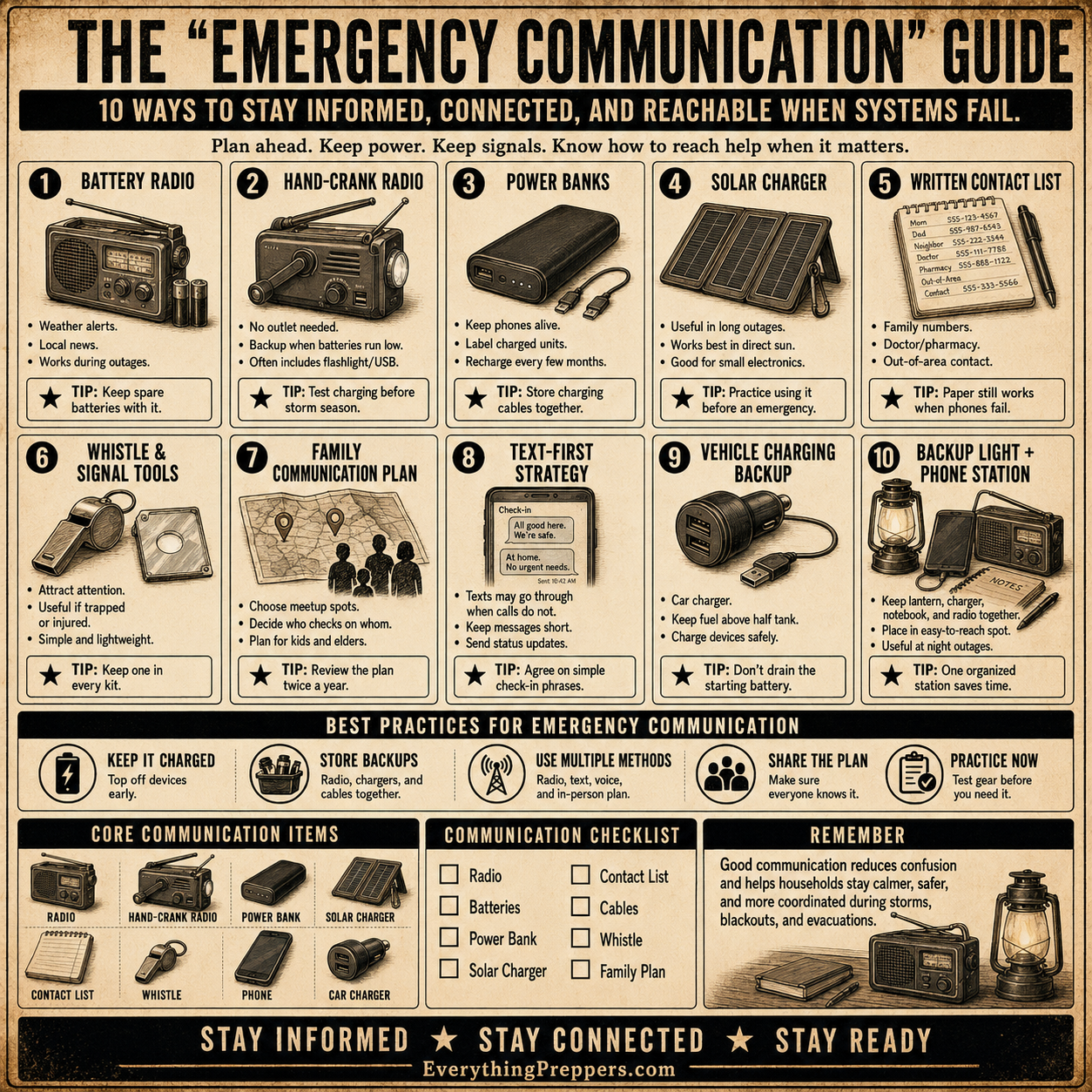
During an emergency, text messages may go through when voice calls do not. Keep an out-of-area contact written on paper so household members have one person through whom they can exchange status information if local communication is disrupted.
6. Battery-Powered or Hand-Crank Radio
Internet service and mobile networks may become overloaded or unavailable.
A battery-powered or hand-crank radio can provide:
- Emergency instructions
- Evacuation information
- Shelter locations
- Road closures
- Water advisories
- Tsunami warnings
- Utility updates
- Aftershock and public-safety information
CDC advises using a battery-operated radio, mobile alerts, or other available communication methods to follow official information after an earthquake. (CDC)
Choose a practical model
Look for:
- AM and FM reception
- Weather-alert capability where available
- Battery and hand-crank operation
- Simple controls
- Headphone jack
- Replaceable batteries
- Built-in light, optional
Do not assume the radio’s built-in phone charger will replace a dedicated power bank. Hand cranking generally produces limited energy.
Store written instructions with the radio and test reception from inside your home.
7. N95 Respirators or Dust Masks
Earthquakes can release dust from drywall, plaster, masonry, insulation, soil, and damaged household materials.
A respirator can reduce the amount of airborne particulate matter inhaled while moving through or cleaning a dusty area.
For substantial cleanup work, CDC recommends at least a disposable NIOSH-approved N95 respirator, along with goggles, gloves, protective clothing, and suitable boots. (CDC)
Choosing the right product
Look for genuine NIOSH approval markings and follow the package instructions.
An N95 should:
- Fit closely over the nose and mouth
- Use both straps when designed with two
- Form a seal around the face
- Be replaced when wet, dirty, damaged, or difficult to breathe through
Facial hair in the sealing area reduces protection.
Important limitations
An N95 protects against particles. It does not protect against:
- Carbon monoxide
- Natural gas
- Chemical vapors
- Solvent fumes
- Oxygen deficiency
Leave the area immediately when you smell gas, experience eye or airway irritation, see an unknown chemical spill, or have difficulty breathing.
Children should not participate in disaster cleanup, and ordinary adult N95 respirators are not designed to fit young children. (CDC)
8. Heavy Work Gloves
Broken glass, nails, sharp metal, splintered wood, and cracked masonry may cover floors and walkways after a quake.
Heavy work gloves protect hands while carefully moving light debris, opening damaged cabinets, and handling emergency equipment.
CDC earthquake-preparedness guidance specifically recommends heavy, durable gloves and sturdy shoes for cleanup and movement through debris. (CDC)
Choose gloves that fit
Store gloves that provide:
- Cut and puncture resistance
- Secure wrist closure
- Good grip
- Enough dexterity for tools
- A comfortable fit for each adult user
Oversized gloves may slip while lifting debris. Gloves that are too small can restrict movement and split at the seams.
Gloves do not make every task safe
Do not use ordinary work gloves to:
- Touch downed wires
- Move energized electrical equipment
- Handle leaking chemical containers
- Enter an unstable building
- Lift large structural debris alone
- Touch broken gas lines
CDC recommends leaving damaged or unidentified chemical containers undisturbed and following local instructions for hazardous-material cleanup. (CDC)
Store eye protection and sturdy closed-toe shoes beside the gloves.
9. Whistle
A whistle allows someone to signal without continuously shouting.
It may be useful when a person is:
- Trapped
- Injured
- Unable to move safely
- Separated from others
- Trying to attract attention in a noisy environment
CDC earthquake-preparedness guidance recommends keeping a whistle or another signaling device in a purse, backpack, or emergency supply kit. (CDC)
Where to keep whistles
A whistle is most useful when it remains within reach.
Keep one:
- On each household member’s emergency bag
- Beside each bed
- With mobility equipment
- In the vehicle
- Attached to a child’s age-appropriate emergency kit
Do not bury it beneath food or water.
Select a loud, durable whistle without a loose internal ball that may jam when wet or dirty. Attach it to a brightly colored cord, but avoid wearing a long cord around the neck where it could become an entanglement hazard.
10. Multipurpose Fire Extinguisher
Earthquake damage can create fires through damaged wiring, gas leaks, overturned appliances, and disturbed cooking equipment.
For many homes, a multipurpose ABC extinguisher is appropriate because it is intended for common combustible materials, flammable liquids, and energized electrical equipment. Choose a model bearing a recognized certification mark such as UL Listed or ULC Listed. (U.S. Fire Administration)
Location
Keep extinguishers:
- Visible
- Near an exit
- Away from the most likely fire source
- Mounted where adults can reach them
- Free from clutter
Do not position the only extinguisher directly above a stove or behind equipment that may be burning.
When to attempt extinguishment
Use an extinguisher only when:
- Everyone has been alerted
- Emergency services have been contacted
- The fire is small and contained
- Smoke is not blocking visibility or breathing
- You have a clear escape route behind you
- You are physically able to operate the extinguisher
- You know which extinguisher to use
Otherwise, leave immediately.
Remember PASS
- Pull the pin.
- Aim at the base of the fire.
- Squeeze the handle.
- Sweep from side to side.
Check the gauge, hose, nozzle, locking pin, and expiration or service instructions regularly. Arrange training through a local fire department when available. (U.S. Fire Administration)
Essential Earthquake Supplies Missing From the Top 10
The ten featured items are a foundation, not a complete household kit.
Consider adding:
Sturdy shoes beside every bed
Broken glass on the floor can cause serious injuries immediately after shaking. USGS recommends wearing sturdy shoes before moving through damaged areas. (USGS)
Prescription medicines and medical equipment
Include medicines, copies of prescriptions, mobility supplies, spare glasses, hearing-aid batteries, and a written medical summary.
Sanitation supplies
Store toilet paper, soap, moist towelettes, garbage bags, disposable gloves, menstrual supplies, and a backup toilet plan.
Warm clothing and blankets
Damaged heating systems, broken windows, or evacuation can expose people to cold weather.
Important documents
Keep copies of identification, insurance information, medical records, emergency contacts, and household inventory in a waterproof and fire-resistant location.
Utility tool
Keep an appropriate wrench or shutoff tool only when your utility provider recommends it. Learn where the controls are and when they should be used.
Do not automatically shut off natural gas after every earthquake. USGS advises turning it off when a leak is suspected because of odor or damaged piping. Once shut off, service may need to be restored by a qualified professional. (USGS)
Pet supplies
Include food, water, medication, leash, carrier, waste bags, identification, and vaccination records.
Store Supplies Where They Will Remain Accessible
A perfect kit is useless when a fallen cabinet blocks it.
Divide supplies between:
- Main household kit
- Bedside modules
- Vehicle kit
- Workplace kit
- Portable evacuation bags
USGS recommends organizing supplies in convenient locations rather than storing everything in one inaccessible area. (USGS)
Avoid high shelves where heavy containers may fall.
Use:
- Low reinforced shelving
- Latching cabinet doors
- Closed plastic bins
- Clear labels
- Removable bags
Anchor storage racks so the supplies themselves do not become falling hazards.
Prepare the Home, Not Just the Kit
Many earthquake injuries are caused by objects that fall, slide, or break.
Before a quake:
- Anchor tall bookcases and cabinets
- Secure televisions and large electronics
- Strap the water heater
- Restrain large appliances
- Install cabinet latches
- Move heavy objects to lower shelves
- Keep beds away from large windows and unsecured shelving
- Repair loose masonry, chimneys, and roof materials
- Learn utility shutoff locations
- Practice the household meeting and communication plan
CDC recommends identifying unsecured furniture, appliances, glass, shelves, cabinets, and structural hazards before an earthquake and securing them where possible. (CDC)
Renters should ask the property owner before drilling or making structural changes, but many hazards can be reduced using approved straps, latches, and removable restraints.
What to Do While the Ground Is Shaking
Supplies matter after the quake. Protective action matters during it.
Indoors
Stay inside and immediately:
- Drop onto your hands and knees.
- Cover your head and neck beneath a sturdy table or desk when one is nearby.
- Hold On until the shaking stops.
Do not run outside or move to another room during strong shaking. Stay away from windows, tall furniture, hanging objects, and fireplaces. (CDC)
Doorways are not automatically safer than other parts of a modern building.
In bed
Stay in bed and cover your head and neck with a pillow unless an immediate hazard is directly above you. Walking across a floor covered with shattered glass may cause injury. (CDC)
Keep shoes and a flashlight within arm’s reach.
Outside
Remain outside and move toward an open area away from buildings, exterior walls, utility wires, trees, and poles. (CDC)
In a vehicle
Pull over safely away from bridges, overpasses, utility poles, and wires. Set the parking brake and remain inside until the shaking stops. (CDC)
What to Do Immediately After the Shaking
Expect aftershocks
Aftershocks can occur minutes, days, weeks, or months after the initial earthquake. Drop, cover, and hold on again whenever shaking resumes. (CDC)
Put on shoes and gloves
Do this before walking through rooms containing broken objects.
Check injuries
Address serious bleeding, breathing problems, and immediate danger first. Do not move a seriously injured person unless remaining in place is more dangerous.
Inspect for hazards
Look and listen for:
- Fire
- Gas odor or hissing
- Sparking or damaged wiring
- Broken water lines
- Structural cracking
- Falling masonry
- Unusual shifting sounds
- Downed utility lines
Do not touch fallen power lines or anything in contact with them. Leave a damaged building when you hear movement, see serious structural damage, or officials instruct you to evacuate. (CDC)
Use flashlights
Avoid flames and electrical switches until gas leaks have been ruled out.
Follow official information
Use the radio, mobile alerts, or text messages to monitor evacuation orders, shelter locations, water advisories, and road conditions.
Coastal areas
When strong or prolonged shaking occurs near the coast, move inland and to higher ground as soon as the shaking stops. Do not wait for an official tsunami warning when natural warning signs are present. (CDC)
A Simple Earthquake Kit Maintenance Schedule
Check the kit every six months.
A practical routine is to inspect it when clocks change or at the beginning of spring and fall.
Review:
- Water dates and container condition
- Food dates
- Medication dates
- Flashlight batteries
- Radio operation
- Power-bank charge
- Respirator condition
- First-aid supplies
- Fire-extinguisher gauge
- Clothing sizes
- Emergency contacts
- Pet needs
- Household evacuation plan
Run a family Drop, Cover, and Hold On drill at the same time.
The best emergency kit is not the one with the most gear. It is the one your household can locate, understand, carry, and use safely.
Final Safety Note
An earthquake kit supports survival and recovery, but it cannot make an unstable structure safe.
During shaking, drop, cover, and hold on. Afterward, expect aftershocks, wear sturdy shoes, avoid damaged buildings and downed wires, and follow official instructions.
Do not use matches, candles, switches, or appliances when a gas leak may be present. Use fire extinguishers only on small, contained fires when you have a safe exit and know how to operate the equipment.
Store at least one gallon of water per person per day for three days and try to build toward a longer supply. Keep emergency food, medicine, communication equipment, protective gear, documents, and household-specific supplies in several accessible locations.